An ensemble is a collection of similarly purposed predictive models. Models may be averaged, compared, or used collectively; here, one model is selected randomly for each recommender decision rather than averaging predictions. section 5.3.1 section 5.3
Figure 5.8 Thompson sampling alters both the fit and the policy. You fit several models—called an ensemble—instead of just one. The policy uses a different, randomly selected model for each decision it makes.
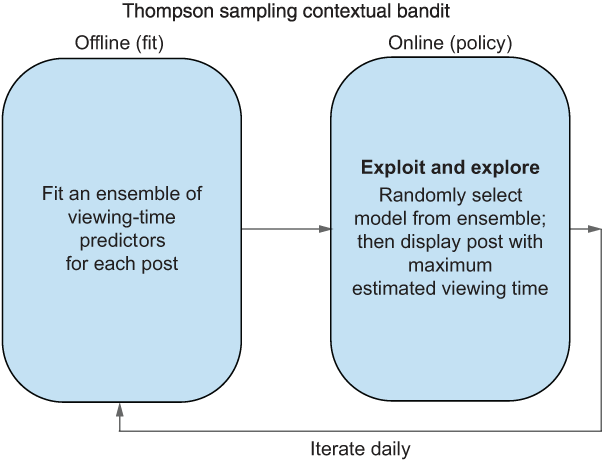
Shows how ensemble construction changes both offline fitting and online policy selection: several models are fitted, then one is randomly selected per decision. section 5.3
Build and operate an ensemble through this workflow:
- Draw a bootstrap sample with replacement from logged samples; duplicates are allowed, and the resampled set may differ in size. section 5.3.1
- Fit a model, such as a linear regression, on each bootstrap sample and repeat until the ensemble has the desired number of models. section 5.3.1
- At decision time, select a model uniformly at random, then choose the action that model predicts will produce the highest reward. section 5.3
- Treat disagreement across similarly fitted models as uncertainty: actions selected by more models receive higher probability, while increasing certainty reduces exploration. section 5.3.2
Ten-model post recommendation
Suppose ten equally believable models evaluate two posts. If seven select post #1 as best and three select post #2, randomized probability matching displays post #1 with probability 7/10 and post #2 with probability 3/10. The policy therefore explores in proportion to model disagreement instead of assigning a fixed fraction of decisions to arbitrary actions. section 5.3.2










