An entity is an object within a data model, described by attributes and connected to other entities through defined relationships. In a relational database, it is typically represented by a table or related tables. section 4.1
A common design mistake is treating entities as arbitrary groupings based only on personal judgment. An Entity Relationship Diagram (ERD) makes entities, attributes, and relationships explicit, while normalization provides methodical rules for reducing duplication and redundancy. section 4.1
Use relationships and keys to decide when data belongs in separate entities:
- Split a one-to-many relationship into separate entities; a sales order can contain multiple ordered products, so order items belong apart from the order. section 4.1.1
- Use a primary key to identify each row and a foreign key to reference a primary key or unique constraint elsewhere. section 4.1.1
- Move reusable details into their own entity instead of duplicating them; employee office information can be stored in Offices and referenced by Employees. section 4.1.1
Figure 4.1 ERD for Sales Orders
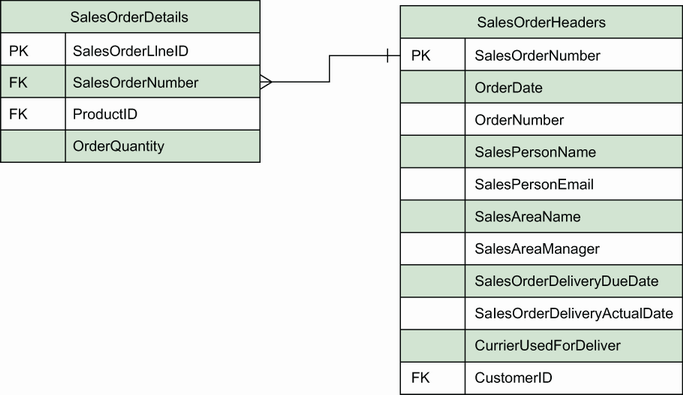
Use the sales-order ERD to inspect entities and their relationships in a concrete schema. section 4.1.1











