An entity is a record-like item in Azure Table Storage, much like a row in a traditional database. It contains properties represented as key-value pairs, while its partition key and row key identify it uniquely. section 5.6 section 5.8
Think of a table of books: one entity can describe a book with properties such as title and book ID. Each entity defines its own schema using JSON, so the table remains schema-less rather than demanding one rigid shape. section 5.6.2 section 5.8
An entity’s identifying keys do two jobs:
- The partition key forms the first half of the unique identifier and guides the physical partition where the data is stored. section 5.6.2
- The row key forms the second half and uniquely identifies the entity within its partition. section 5.6.2
- Careful partition choices can improve access patterns, while Azure can move heavily loaded or oversized partitions between machines. section 5.6.2
Adding a book entity
PowerShell retrieves the table’s CloudTable object, then Add-AzTableRow inserts an entity with partition key bookkey1, a generated GUID row key, and title and bookid properties. section 5.6.2
Figure 5.16 The entity, property, and key-value pairs of a table in Table Storage
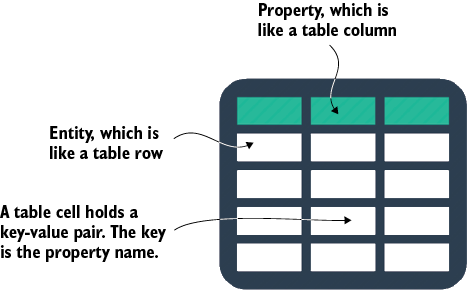
Inspect the visual relationship between a table, an entity, its properties, and their key-value pairs. section 5.6













