An entropy source is the physical process sampled by a true random number generator (TRNG) to produce uncertain values. Its output may be biased or degraded, so production systems commonly apply randomness extraction before using it. section 2.2.1
Treat an entropy source as an engineered security boundary:
- Ground its generation rate and entropy in a physical model that can withstand skeptical review. section 2.2.1
- Expose raw output so a health checker can compare observed bits with the model’s predictions. section 2.2.1
- Shut down access when health checks detect malfunction, and defend against power-noise injection or malicious hosts. section 2.2.1
Practical failure modes
Zener-noise and ring-oscillator TRNGs illustrate why a physical model matters. Intel’s RDRAND hides the circuit between the entropy source and reported output, while USB TRNGs can be modified by a malicious host to produce permanently predictable bits. section 2.2.1
Figure 2.4 TRNGs sample physical phenomena to generate random numbers.
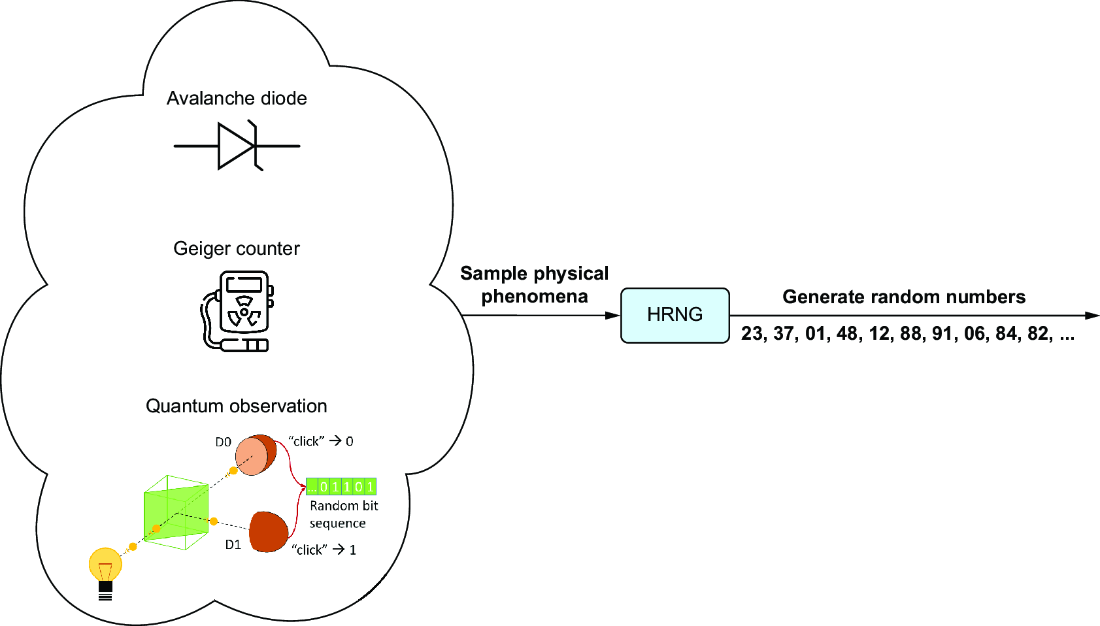
Shows how TRNGs sample physical phenomena to generate random numbers. section 2.2.1

