Epistemic uncertainty is uncertainty caused by incomplete knowledge. In prediction, it appears when limited data leave several plausible models or parameter settings, especially in regions with few or no observations. Unlike aleatoric uncertainty, which comes from inherent data noise, epistemic uncertainty can be reduced by gaining more knowledge or data. section 10.1
Recognize epistemic uncertainty when:
- A model extrapolates beyond its training data and produces a confident single prediction despite knowing little about the underlying function. section 10.1
- Many parameter configurations explain limited observations almost equally well, so committing to one configuration hides model ambiguity. section 10.1
- A Bayesian neural network represents weights and biases with probability distributions, allowing predictions to reflect uncertainty about the model. section 10.9
A noisy sine function
Imagine training a neural network on noisy samples from a sine function. Between observed samples, the network may interpolate well; far outside the observed range, however, many functions remain plausible. A standard network selects one set of weights and may appear certain, while a Bayesian treatment represents the remaining uncertainty across models. More data in the sparse region can reduce this epistemic uncertainty. section 10.1
Figure 10.3 Predictions made by a standard neural network, which don’t include uncertainty quantification despite its importance in indicating both observation noise and data sparsity.
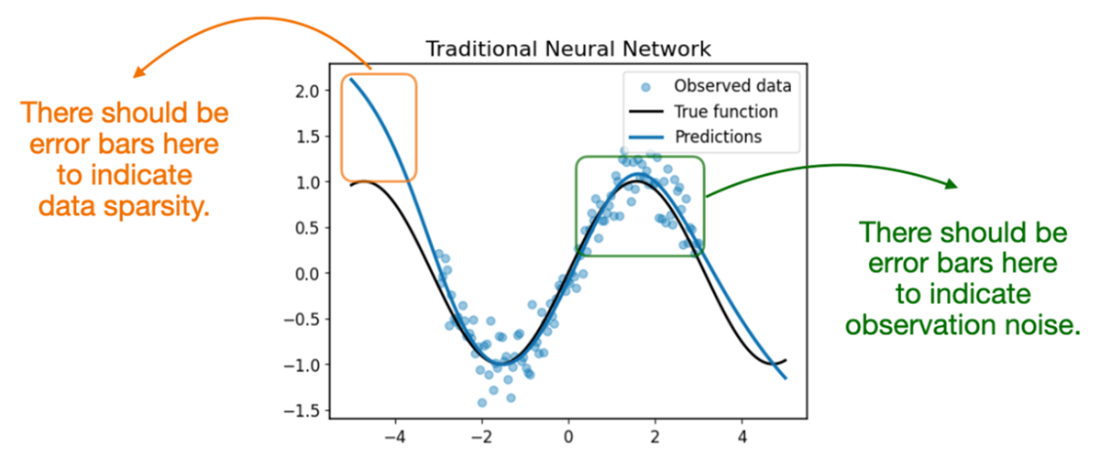
Compare standard neural-network predictions with the missing uncertainty information around noisy observations and data-sparse regions. section 10.1

