liveBook · Manning

Error

As explained in Data Without Labels

Prediction error is the discrepancy between a model's predicted output and the corresponding actual value.

Prediction error is the difference between actual values and predicted values. Reducing this discrepancy improves accuracy and guides model optimization. section 8.2.6 section 8.3.4

Error supports several training decisions:

  • Use the loss score derived from predictions and actual values as feedback for adjusting weights. section 8.3.4
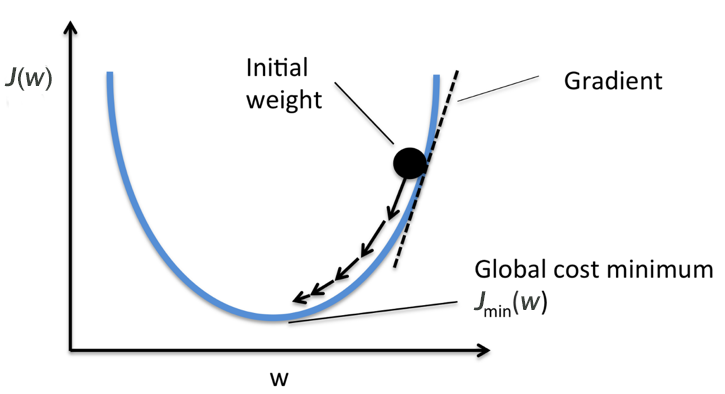
  • Reduce error with gradient descent, which moves iteratively toward a function's global minimum. section 8.2.6
  • Choose batch, stochastic, or mini-batch updates according to dataset size, speed, accuracy, and batch-size tuning needs. section 8.2.6

Training feedback

After a network generates predictions, compare them with the actual values to calculate prediction error. Convert that result into a loss score, then use backpropagation to adjust the weights and lower future error. section 8.3.4

Figure 8.8 The concept of gradient descent. It is the mechanism to minimize the loss function.
figure

Use the gradient-descent figure to visualize how iterative updates move toward the minimum of the loss function. section 8.2.6

How Data Without Labels covers it

How deep it goes
Defines error, connects it to loss and backpropagation, and compares update strategies without specifying an error formula.
Examples
Uses predicted-versus-actual values, gradient-descent movement, and batch, stochastic, and mini-batch training updates.
What it assumes
Assumes predicted and actual values, while defining their difference and linking it to model accuracy.
What you can do after
Diagnose training progress by comparing predictions with actual values and use resulting loss feedback to adjust model weights.
How it connects
Connects error with loss functions, gradient descent, backpropagation, weights, biases, and accuracy.

Related concepts

This explainer was generated by Manning's knowledge graph from the text of Data Without Labels. The section links point to the parts of the book it draws on.