An estimation register is an n-qubit quantum register whose measured integer outcomes encode an estimate produced by a quantum estimation algorithm. In quantum phase estimation, it captures the phase of an eigenvalue; in amplitude estimation, it captures the rotation information used to estimate good-outcome probabilities or counts. section 9.3 section 9.6.1
A phase-estimation workflow uses the register as follows:
- Initialize every estimation qubit with a Hadamard gate, creating the superposition used to sample powers of the target circuit. section 9.3
- Apply controlled powers U^(2^k) to a target register, using estimation qubit k as the control. section 9.3
- Apply the inverse quantum Fourier transform, then measure the estimation register and select a frequent outcome v as the estimate. section 9.3 section 9.7
Circuit construction separates the estimation register from the target register. The reusable phase_estimation_circuit function allocates n estimation qubits, optionally prepares an eigenstate, applies controlled powers, reverses that preparation, and performs the IQFT. section 9.4
Quantum counting
Amplitude estimation uses an estimation register alongside a target register prepared by A. Controlled powers of the Grover iterate are followed by an IQFT; the most frequent estimation outcome can then determine how many oracle-tagged outcomes exist. With three target qubits, five estimation qubits, and items [0, 1, 2], the reported count is 3. section 9.6.1 section 9.6.2
Figure 9.17 The QPE algorithm where U is an m-qubit circuit and E prepares an eigenstate of the circuit
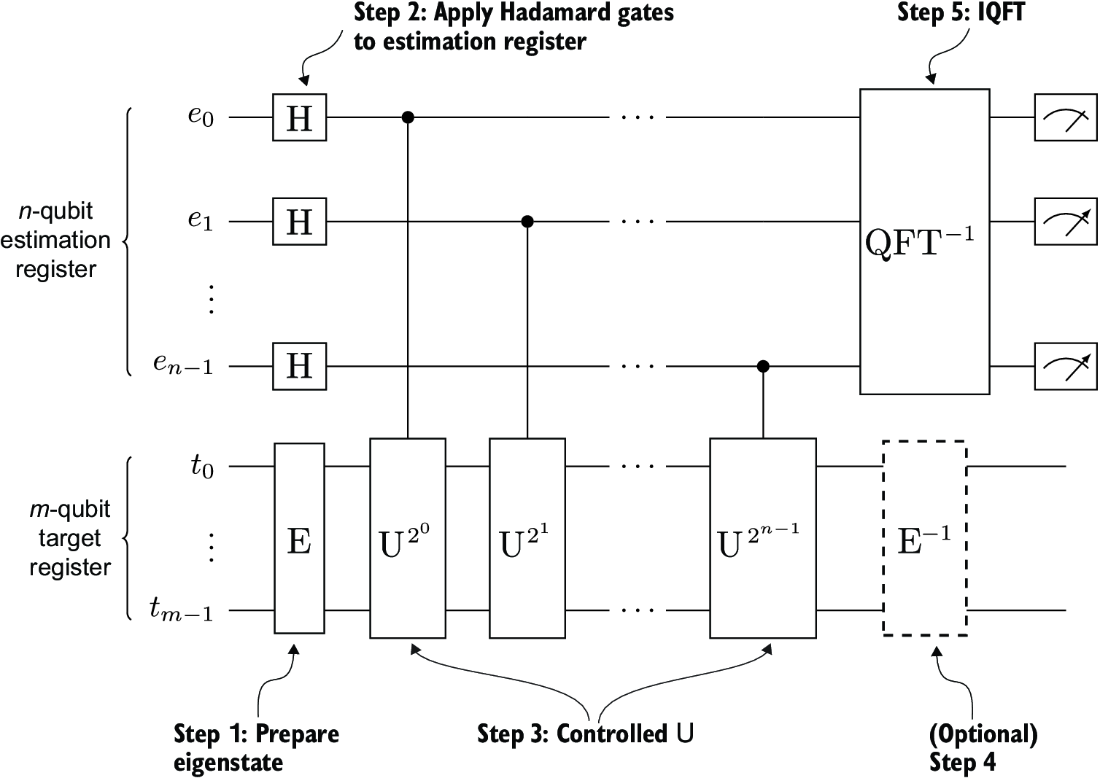
Use the circuit diagram to trace the estimation register, target register, controlled circuit powers, optional eigenstate unpreparation, and final IQFT. section 9.3
