An estimator is consistent if it converges toward the true parameter value as the sample size increases. This describes the estimation procedure’s long-run behavior, not whether any single estimate is accurate. section 3.2.1
Consistency depends on the statistical model’s assumptions, including independent observations and a correctly specified probability model. Small-sample estimates may fluctuate; consistency means they increasingly concentrate around the true value as data accumulate. Unlike unbiasedness, it concerns long-run behavior rather than finite-sample averages. section 3.2.1
Estimating a population mean
If a normal population has known variance and true mean μ = 5, small samples may yield sample means above or below 5. As observations accumulate, the sample mean stabilizes and converges toward 5, though each successive estimate need not be closer than the last. section 3.2.1
Figure 3.1 As the sample size increases, the sample mean converges toward the true population mean (𝜇 = 5). Although estimates from small samples fluctuate because of random sampling variation, those fluctuations diminish as additional observations are incorporated, illustrating the consistency of the sample mean.
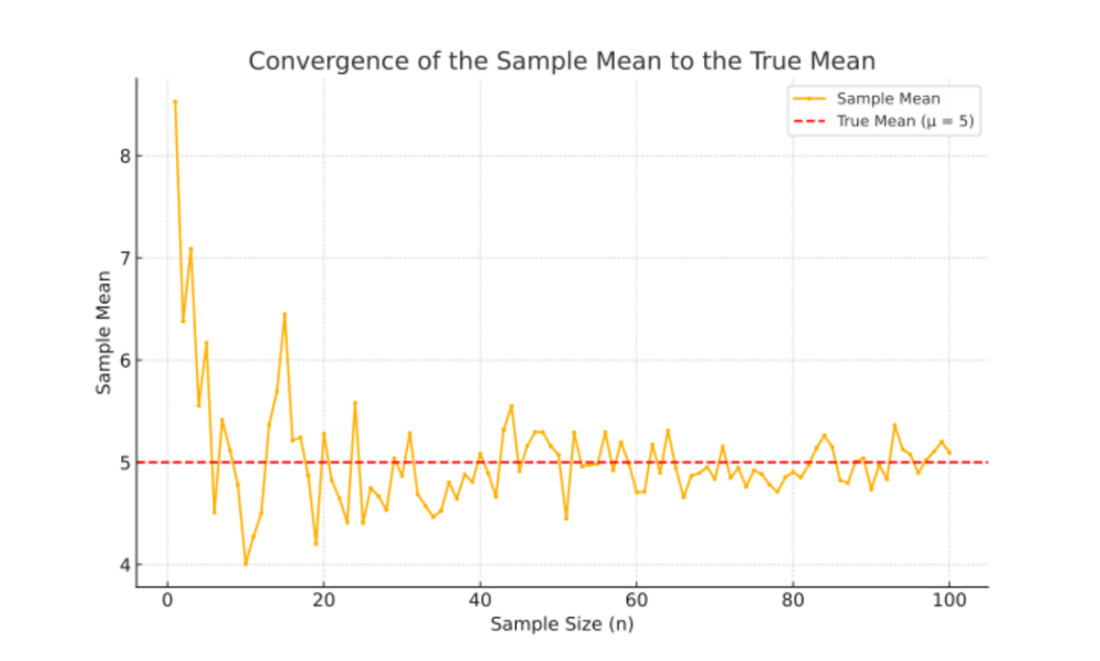
Shows sample-mean estimates fluctuating less and converging toward μ = 5 as sample size grows. section 3.2.1

