Ethernet is a family of wired networking standards, not one cable or protocol. IEEE 802.3 defines physical connection characteristics and rules for formatting data sent across wired networks. section 3.0 section 3.1
Ethernet supports copper and fiber-optic connections. Copper UTP is common because it costs less, while fiber supports much longer distances but requires more expensive transceivers. section 3.3 section 3.5
Key Ethernet facts include:
- Copper Ethernet commonly uses eight-position, eight-contact (8P8C) connectors, commonly called RJ45, with four twisted wire pairs. section 3.3
- 10BASE-T and 100BASE-T use two wire pairs; 1000BASE-T and 10GBASE-T use all four. section 3.5
- Common copper standards range from 10BASE-T at 10 Mbps to 10GBASE-T at 10 Gbps, with a 100-meter maximum cable length. section 3.3.1
- UTP twisting reduces electromagnetic interference between wires, but cables longer than 100 meters can suffer attenuation and reduced performance. section 3.3 section 3.3.1
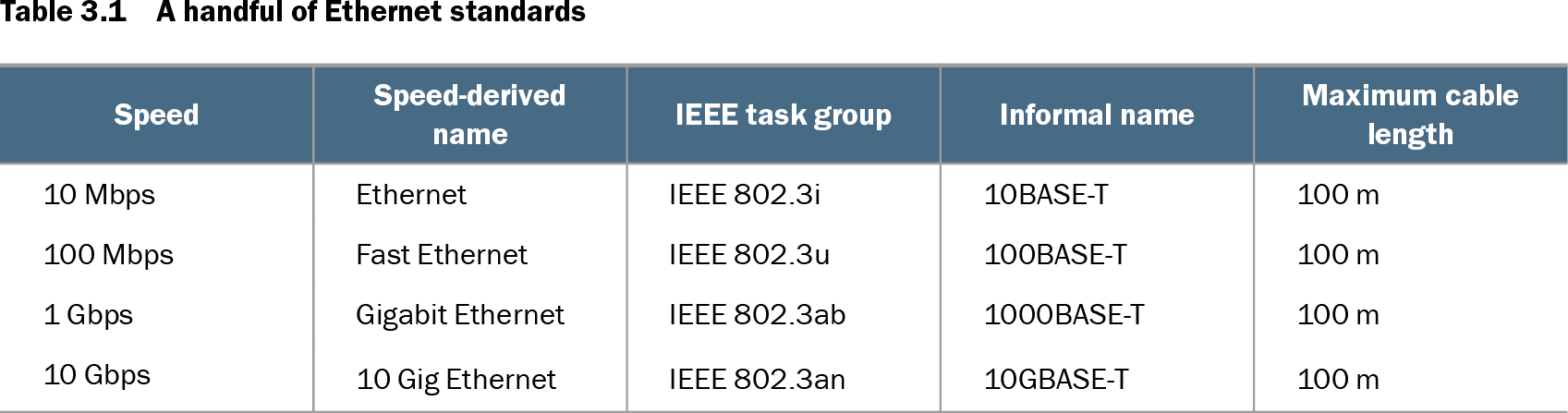
Table 3.1 A handful of Ethernet standards (view table figure)
| Speed |
Speed-derived name |
IEEE task group |
Informal name |
Maximum cable length |
|---|---|---|---|---|
| 10 Mbps |
Ethernet |
IEEE 802.3i |
10BASE-T |
100 m |
| 100 Mbps |
Fast Ethernet |
IEEE 802.3u |
100BASE-T |
100 m |
| 1 Gbps |
Gigabit Ethernet |
IEEE 802.3ab |
1000BASE-T |
100 m |
| 10 Gbps |
10 Gig Ethernet |
IEEE 802.3an |
10GBASE-T |
100 m |
Compare Ethernet speed names, IEEE task-group names, informal names, and maximum cable lengths. section 3.3.1