An ethnographic field note is a written record that helps a facilitator observe group patterns without letting unexamined personal reactions steer the work. Alongside symbols of power, anecdotes, and other observations, record your own “shadows”: the emotions, judgments, or reactions that arise while listening. Naming them does not make them irrelevant; it keeps them visible so they are less likely to distract from what is happening in the group. section 6.3.1
Field notes support active listening before and during collaborative modeling. They create material for later reflection and inner work, while also preserving observations that can help facilitate a session. This is particularly useful when rank, power, or conflict may shape who speaks, whose view is accepted, and what remains implicit. section 6.3.1 section 6.5
Use field notes as a lightweight observation practice:
- Write down observable symbols of power, such as signals of explicit or implicit ranking. section 6.3.1
- Capture anecdotes and contextual thoughts rather than relying only on memory after an interview or session. section 6.3.1
- Separate your reactions from claims about the group by explicitly noting emotions or judgments as shadows. section 6.3.1
- Review the notes afterward to reflect on your own stance and prepare a more neutral facilitation approach. section 6.3.1 section 6.5
Preparing a cross-organizational modeling session
Before a collaborative modeling session, conduct interviews and maintain notes on participants’ stated goals, perceived obstacles, and signs of power or rank. Add your own reactions separately. Use the resulting observations to anticipate implicit ranking and to shape a safer, more balanced session rather than treating the notes as a verdict on individuals. section 6.3.1 section 6.5
Figure 6.3 An example map of how to model the organization and capture symbols, anecdotes, and our own thoughts. In reality, this would be a lot bigger, so we like to use online tools where we can easily enlarge the area and collaborate on capturing our observations.
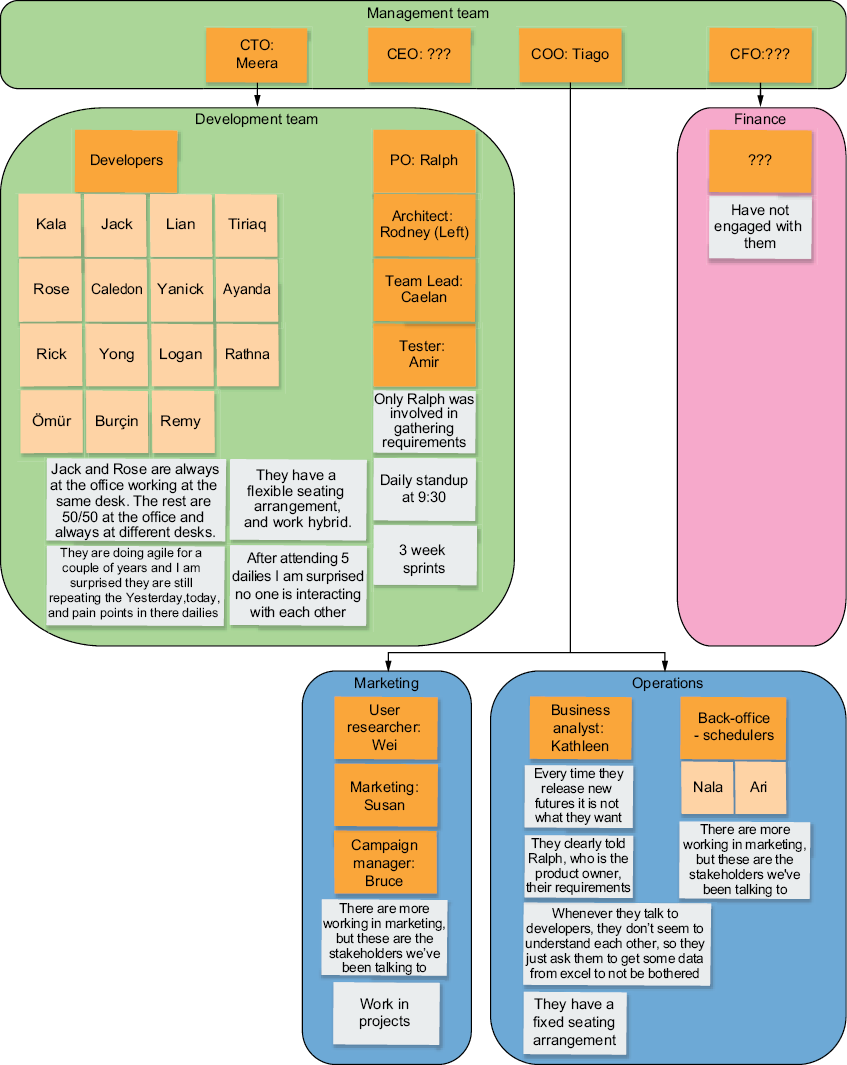
Use an observation map to keep symbols, anecdotes, and personal reflections visible together while preparing or reviewing collaborative work. section 6.3.1
Field notes are not a substitute for facilitation choices. Pair them with interviews, collaboratively agreed safety rules, and participation practices that make room for people with different levels of power. Their value lies in helping the facilitator notice patterns and examine bias before acting on an interpretation. section 6.3.1 section 6.5
