Euclidean space represents points as coordinate vectors, measures distance with straight lines, and follows the Pythagorean theorem. It is the default geometric setting for many machine-learning models and embeddings. section 11.1.1
Key properties include:
- Representing an item as coordinates such as (0.5, 0.3). section 11.1.1
- Calculating distance as the square root of the sum of squared coordinate differences. section 11.1.1
- Treating relationships as uniform, with space between points remaining constant regardless of position. section 11.1.1
Graph embeddings
An encoding function maps graph nodes into a multidimensional Euclidean embedding space. Training can arrange the vectors so that distances reflect relevant relationships in the original graph, although hierarchical structures may fit hyperbolic space better. section 11.1.1
Figure 11.2 Euclidean vs. non-Euclidean space [3]. Pixels in an image are all equally distant from each other and have eight neighbors (except those on the border). In a graph, the number of neighbors can vary enormously from one node to another.
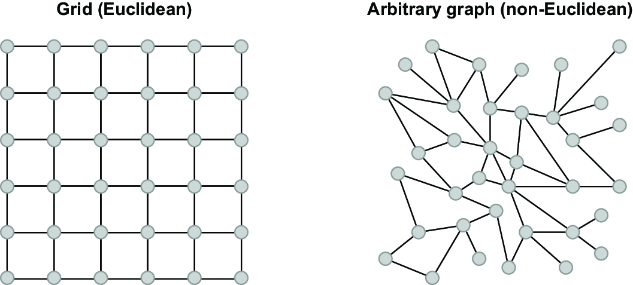
Compare Euclidean regularity with graph structure: image pixels have predictable neighborhoods, while graph nodes can have widely varying numbers of neighbors. section 11.1.1
