Hyperbolic space is a negatively curved embedding space whose available volume grows exponentially with distance from a center, unlike Euclidean space, where growth is polynomial. section 11.1.1
Coordinates still represent vectors, but distances expand as points approach the boundary, so hyperbolic similarities require specialized distance formulas. section 11.1.1
Hyperbolic embeddings are especially useful when graph structure is hierarchical:
- Corporate organizations, biological taxonomies, and internet network topologies can map more faithfully than in Euclidean space. section 11.1.1
- The expanding geometry accommodates branching structures whose available relationships increase rapidly across levels. section 11.1.1
Choosing an embedding geometry
Use Euclidean embeddings when relationships are relatively uniform; consider hyperbolic embeddings when a graph contains strong hierarchy and branching. section 11.1.1
Figure 11.1 The node embedding problem. The goal of the task is to learn an encoding function, encode(x), that maps nodes to a multidimensional embedding space. These embeddings are optimized so that distances in the embedding space reflect relevant aspects of the original graph, such as the relative positions of the nodes.
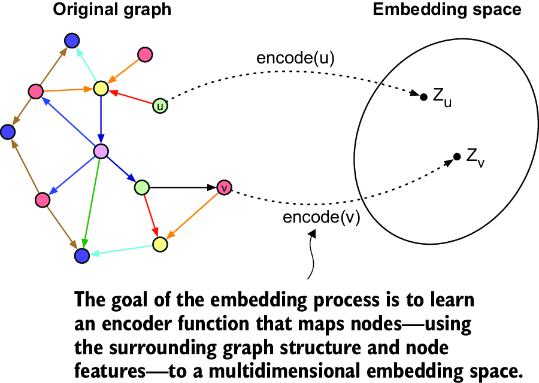
Relate the geometry to node embedding: an encoding function maps graph nodes into a space where distances preserve relevant graph structure. section 11.1.1
