Evaluation measures whether a model solves problems correctly rather than merely producing convincing-sounding responses. The workflow generates outputs, extracts final answers, verifies them against reference solutions, and aggregates scores across many examples. section 3.0
A practical evaluation loop connects measurement to model improvement:
- Start with a conventional pretrained LLM as the baseline. section 1.7
- Run benchmark-based or judgment-based evaluation using tools that score generated outputs. section 1.7
- Apply inference-time methods or additional training, then return to evaluation to measure whether performance improved. section 1.7
- Track validation loss separately from training loss because held-out validation results provide a less noisy progress signal. section 8.8
Verifying mathematical answers
A verification-based evaluator extracts an LLM’s final answer and compares it with the reference solution using a calculator-like symbolic math solver. Running the pipeline over MATH-500 produces task accuracy for each checkpoint, while validation-loss curves show training progress and diminishing returns. section 3.0 section 8.8
Figure 1.9 A high-level road map of what we’ll build in this book. We’ll start with a conventional LLM, add evaluation methods so we can measure its progress, and then explore two broad families of reasoning improvements: inference techniques and training techniques.
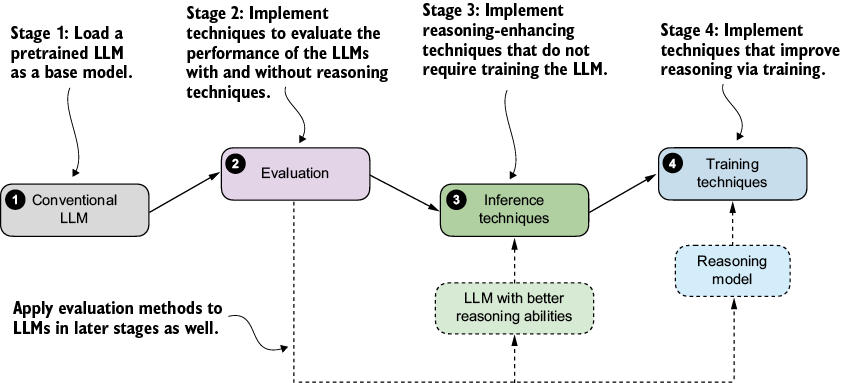
Use the roadmap to locate evaluation between loading a base LLM and applying inference-time or training-time reasoning improvements. section 1.7














