Evaluation systematically tests whether a search system or model delivers relevant, useful results before release and during iteration. It prevents teams from optimizing the wrong component and connects technical performance with user experience, accuracy, usability, and adoption. section 1.5 section 7.2.3
A practical evaluation path moves from inexpensive feedback toward more reliable measurement:
- Start with qualitative checks: have users perform realistic tasks, collect feedback, manually assess relevance, and observe whether results support their work. section 7.2.3
- Add quantitative measures as data and optimization needs grow; search quality can be assessed with precision, recall, and mean reciprocal rank. section 7.2.3 section 7.3.2
- For retrieval-augmented generation, evaluate retrieval, response generation, and the complete system separately, fixing variables when isolating prompt or component changes. section 7.3.2
- Extend evaluation with real user queries and responses so the test set reflects actual use cases rather than only development assumptions. section 7.3.2
Testing a workplace search system
A marketer searches for “Advanced plan performance feedback” and reports whether the results are relevant or require digging through irrelevant documents. Evaluators then rate results for “API integration case studies” against the query’s intent, while observing whether the system helps a team write a case study. section 7.2.3
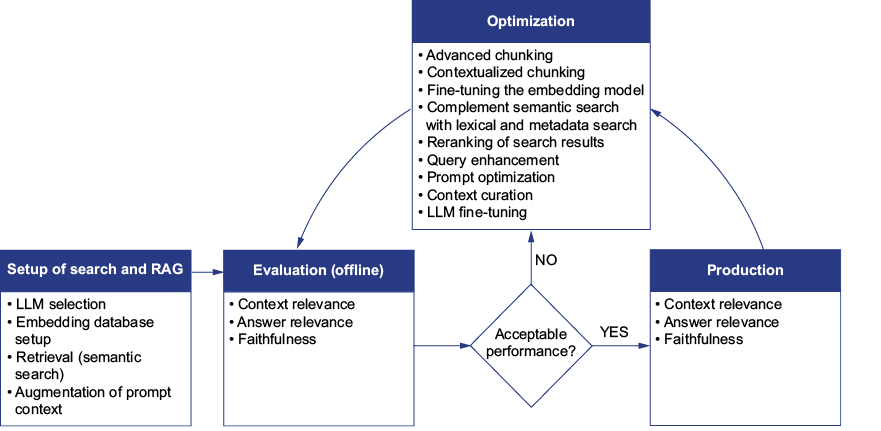
Use the lifecycle view to connect initial setup, continuous evaluation, and iterative refinement across semantic search and RAG. section 7.0














