Event-driven architecture initiates computation when an event arrives rather than keeping request-handling servers continuously running. In model serving, a user request is the event: the system acquires needed resources, loads a trained model from a distributed database, and produces a prediction for the request. section 4.4.2
This pattern addresses services whose traffic is sparse, irregular, or difficult to forecast. Resources come from a shared pool only when requests occur, allowing a serving system to absorb an unexpected traffic surge while avoiding resources that would otherwise sit idle during quiet periods. section 4.4.2 section 4.9
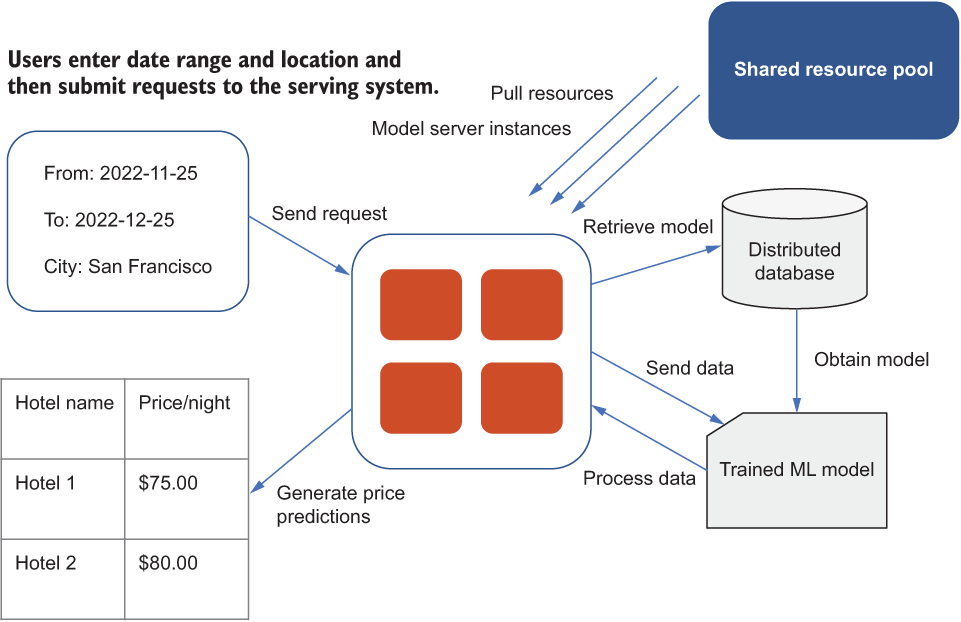
The request-triggered path shows a hotel-price query activating model serving rather than relying on an always-running serving process. section 4.4.2
Event-driven serving is a practical fit when it needs to:
- Respond with real-time, more accurate predictions immediately after users submit requests instead of returning predictions calculated on a schedule. section 4.4.3
- Scale model-serving functions automatically as traffic grows, without developers manually allocating the serving resources. section 4.4.3
- Deploy a trained model as a request-triggered function, with source code as the deployable input rather than a long-running service artifact. section 4.4.3
Event-driven processing is not a universal replacement for long-running serving systems. Replicated and sharded services keep servers running and suit heavy load, large in-memory data, or background processing. Regularly scheduled predictions may not need event monitoring, and applications that accept less-accurate results can recalculate predictions at a daily or weekly granularity instead. section 4.4.2 section 4.4.3
Hotel price prediction on demand
A time-and-location price query triggers the serving function. It draws resources from the shared pool, retrieves and loads the trained model, estimates the hotel price, and releases the system from maintaining capacity for periods without queries. section 4.4.2
Rate limits may still constrain an event-driven service. When four serving requests arrive but only two are permitted concurrently, the allowed requests run first and the remaining requests wait in a queue until capacity becomes available. section 4.4.2









