liveBook · Manning

Event-driven architecture

As explained in Google Anthos in Action

Event-driven architecture is a software architecture in which components communicate and initiate processing through events.

Event-driven architecture coordinates processing through events from internal or external sources. In Knative Eventing, event sources send events to a Broker, Triggers filter and route them, and target Services process them. section 9.3.3

Knative implements the pattern through:

  • CRDs and controllers that define and manage event handling. section 9.3.3
  • Brokers that receive or pull events as an event mesh. section 9.3.3
  • Triggers that filter events and route them to Knative or Kubernetes Services. section 9.3.3
  • Pluggable event storage, CloudEvents parsing, automatic scaling, and predefined or custom sources. section 9.3.3
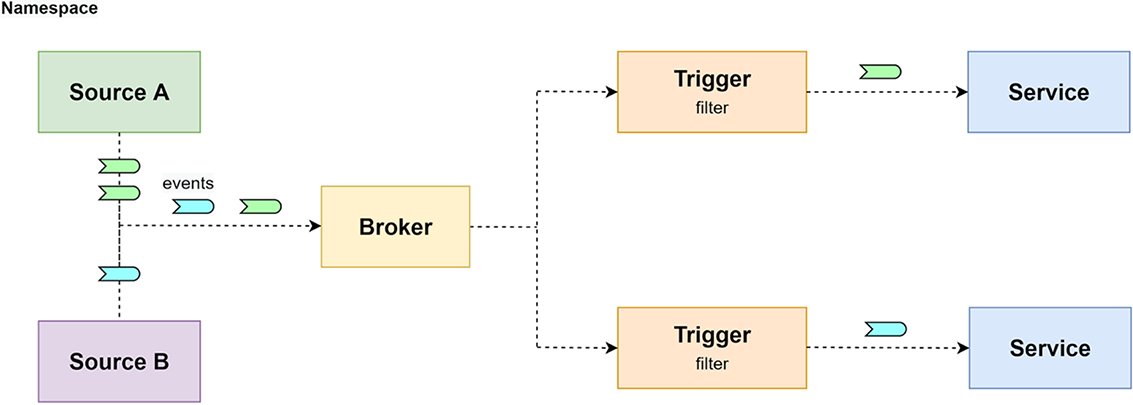
Figure 9.6 Knative Eventing resources
09-06

Use the resource diagram to trace event flow from sources through a Broker and Trigger to a Service. section 9.3.3


How Google Anthos in Action covers it

How deep it goes
Explains Brokers, Triggers, sources, storage, scaling, and basic pipelines, while deferring complex event pipelines.
Examples
Uses Broker and Trigger manifests, a Cloud Pub/Sub source, and event flow diagrams as implementation examples.
What you can do after
Operate/configure Knative Eventing pipelines that route events from sources to scalable services.
How it connects
Connects event-driven architecture with Knative Eventing, Kubernetes Services, Knative Serving, CloudEvents, Brokers, and Triggers.

Also explained in

Compare how 10 books explain event-driven architecture →

Related concepts

This explainer was generated by Manning's knowledge graph from the text of Google Anthos in Action. The section links point to the parts of the book it draws on.







