The event loop is part of JavaScript’s runtime scheduling architecture. It works with a callback queue to run pending asynchronous work while the main thread continues. This gives a single-threaded JavaScript program a way to handle events and delayed results without writing every operation as a blocking sequence. section 1.5 section 8.0
Callbacks and promises both use this architecture. A mouse event or HTTP request can provide a callback; a promise instead gives the eventual result a consistent API. With `doSomething().then(doSomethingElse)`, `then` marks what should happen after the first operation produces its result. `async`/`await` makes that flow look linear, but still relies on promises and the event loop. section 8.2 section 1.5
Reading a file without a synchronous call
Compare `fs.readFileSync('blocks.txt')` with `fs.readFile('blocks.txt', callback)` or `fs.promises.readFile('blocks.txt').then(handleData)`. The latter two express work whose result arrives later; the promise form separates the eventual value from the function that handles it. section 8.2
Scheduling also matters during module loading. If a module uses top-level `await`, a module that imports it must wait for it to finish. Other sibling dependencies can continue loading, so the wait need not stop unrelated work. section 8.6
Figure 8.2 A simplified view of how the Node.js architecture handles asynchronous tasks. The event loop time slices these tasks so that code never blocks, providing the illusion of concurrency.
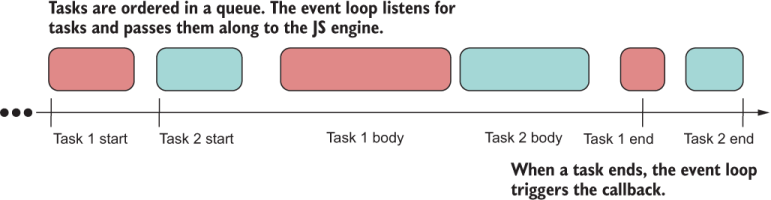
A simplified Node.js diagram illustrates how the event loop interleaves asynchronous tasks with continuing code. section 8.2










