An event processing network (EPN) is a model of the functional behavior of an event processing system. It brings together event producers, event consumers, event processing agents, channels, and global state elements. The model describes how events are processed without necessarily specifying the system’s physical implementation. section 2.2.2 section 6.1
Producers emit events, and consumers receive them. Between them, event processing agents accept events and emit further events. Channels carry those events between components; global state elements represent state accessed by agents. An EPN can describe one application or support multiple related applications. section 2.2.2 section 6.6
Figure 6.1. An example event processing network, showing the graphical notation we are using, and illustrating some of the features of an EPN
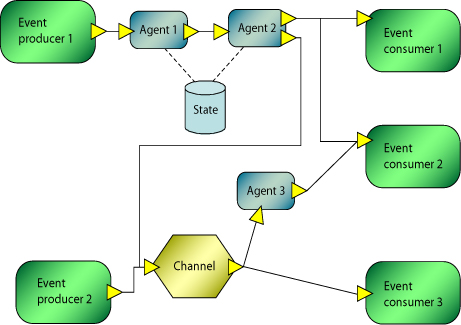
The diagram shows the EPN notation and how links connect processing elements. section 6.1.1
An EPN can be drawn as a graph. Nodes represent producers, consumers, agents, and explicitly modeled channels. Triangular terminals show where events enter or leave a node, and solid links show event flow from an output terminal to an input terminal. Terminals can be labeled with event types; agent input terminals can also have filters that restrict which event instances they accept. section 6.1.1 section 2.3.5
Links can express several event-flow patterns:
- One output can connect to multiple inputs. Each receives a copy of an emitted event, but the notation does not dictate the distribution order. section 6.1.1
- Multiple outputs can connect to one input. Events from the incoming links are interleaved in an implementation-dependent manner. section 6.1.1
- An explicit channel can be modeled as a network element; other channels may appear as wiring between elements. section 2.2.2
EPN models can be nested inside one another to simplify complex networks and reuse models. The network describes functional relationships; implementation artifacts need not correspond directly to the diagram. section 6.1
Fast Flower Delivery
The Fast Flower Delivery application can be modeled by identifying its event processing agents, channels, and global state elements, then showing how they connect producers to consumers. section 6.0