Event transformation creates output events based on one or more input events. It can change an event’s representation, add information through enrichment, or remove information through projection. Transformation is an intermediary capability in an event processing network, alongside filtering and pattern detection. section 8.2 section 2.2.3 section 1.4.4
A transformation is stateless when each input event is processed independently and each output is derived from one input. It is stateful when an output may be derived from multiple input events. Agents can also be classified by their numbers of input and output streams. section 8.2
Transformation can take several forms:
- Enrichment adds information; projection removes information. section 2.2.3
- Split turns one incoming event into multiple events, each containing a subset of the original information. section 2.2.3
- Aggregate derives events from a stream, typically using more than one input event; for example, an output may contain a running total. section 2.2.3
- Compose joins two input streams by matching or correlating events from them. section 8.5
Figure 8.5. Classification of the different types of Transformation agents. The triangles represent event instances; the arrows show the number of input and output streams for each type.
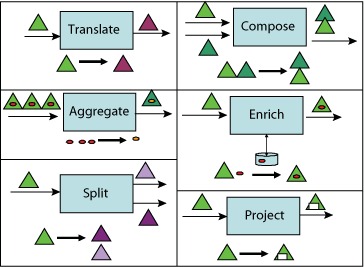
The classification diagram compares transformation agents by state and by the number of input and output streams. section 8.2
Enriching a delivery request
A Fast Flower Delivery transformation adds a location attribute to a Delivery Request event. One implementation expresses this enrichment in Apama MonitorScript. section 8.4
Transformation can address event payload attributes as well as header attributes. XSLT can derive output events in many transformation agents, while event processing products may use different languages and programming styles. section 8.2 section 8.5 section 8.4