Where did my order go?
A customer places an order and immediately refreshes Recent Orders. The shipping status still says “Pending,” or the order is missing, because the shipping service has not processed the message yet. The order and shipping views temporarily tell different stories. section 7.3
Eventual consistency allows distributed state to differ temporarily as updates propagate. If no new updates are made to a data item, accesses to it will eventually return the last updated value. The promise is convergence, not an instant update or a specified waiting time. section 7.3.1
Think of a coffee shop: the cashier takes your order and serves the next customer while the barista makes your drink. You wait, but the line keeps moving. Similarly, an event producer can move on while a consumer processes the event later. Asynchronous processing creates a gap that the system must be designed to handle. section 7.3.2 section 7.9
Figure 7.6 Synchronous systems block the line (the CPU) until the work is done. Asynchronous systems take the order and promise to do the work later.
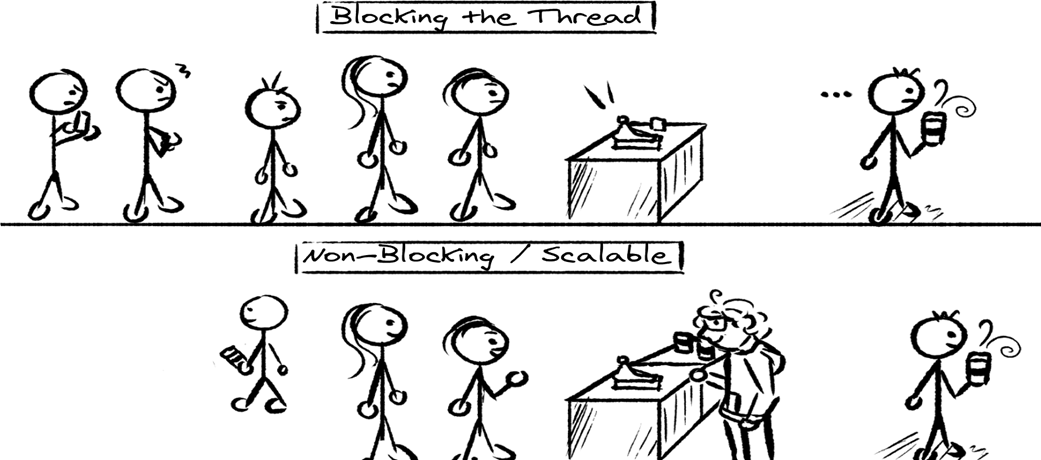
Compare a line blocked by synchronous work with an order accepted for later processing. section 7.3.2
The tradeoff is useful, not free: a producer may keep accepting orders while a consumer is unavailable, but readers can see stale data. A broker buffers messages during consumer outages. Eventual consistency does not mean a system can never fail, and asynchronous communication alone does not guarantee convergence. section 7.3.4 section 7.9
Choose the consistency requirement by consequence:
- A social-media like count can often tolerate a delay. section 7.3.2
- A checking balance or inventory count needs more care: stale data can permit an unacceptable result. section 7.3.2 section 8.2.2
- If writes are accepted during a network partition, plan recovery. A saga can use compensating transactions to correct mistakes after the partition heals. section 7.3.5
CAP frames the consistency and availability choice during a network partition; PACELC also considers latency and consistency when the network is healthy. These are design tradeoffs, not a blanket instruction to make every part of a system eventually consistent. section 7.3.5 section 7.3.2









