liveBook · Manning

Evolution

As explained in Architecture Modernization: Socio-technical alignment of software, strategy, and structure

Evolution is the progression of a component from novel and uncertain origins toward increasingly industrialized, stable, and efficient forms.

Evolution describes a component’s movement from uncertain, novel origins toward increasingly ordered, known, stable, measured, and efficient forms. In Wardley Mapping, components may also die, and their position is a reasoned assessment rather than an objective fact. section 5.4.1

Use evolution as a collaborative way to examine change:

  • Assess a component against characteristics such as uncertainty, predictability, stability, and competitive advantage. section 5.3.2 section 5.4.1
  • Discuss divergent assessments instead of forcing a supposedly correct placement; disagreement exposes differences in mental models. section 5.3.2
  • Consider demand, competition, external events, and emerging components when anticipating future movement. section 5.4 section 5.4.1

From novelty to expectation

Mobile-phone cameras illustrate evolution: they began as an exciting, differentiated capability and became a table-stakes expectation, while retaining limited room for differentiation. section 5.4.1

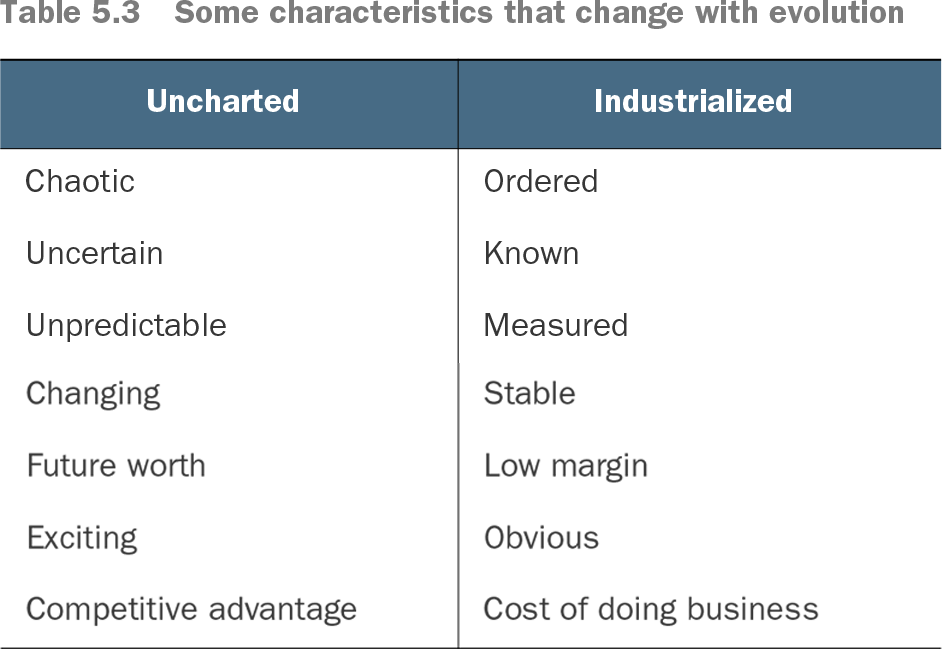
Table 5.3 Some characteristics that change with evolution (view table figure)

Uncharted

Industrialized

Chaotic

Ordered

Uncertain

Known

Unpredictable

Measured

Changing

Stable

Future worth

Low margin

Exciting

Obvious

Competitive advantage

Cost of doing business

Compare the uncharted and industrialized ends of evolution across uncertainty, order, predictability, stability, margins, and competitive advantage. section 5.4.1


How Architecture Modernization: Socio-technical alignment of software, strategy, and structure covers it

How deep it goes
Explains an evolution spectrum and a collaborative assessment process, while leaving placement partly subjective and requiring further research.
Examples
Uses smartphone cameras, evolution criteria, breakout discussions, and a visual mapping template as concrete learning artifacts.
What it assumes
Assumes a component to assess and characteristic lists, while teaching first-time mappers how to reason about evolutionary stages.
What you can do after
Evaluate component positions, challenge maps through discussion, and anticipate changes driven by demand, competition, and external events.
How it connects
Connects evolution with Wardley Mapping, climatic forces, supply and demand, competitive advantage, and organizational course correction.

Also explained in

Compare how 3 books explain evolution →

Related concepts

This explainer was generated by Manning's knowledge graph from the text of Architecture Modernization: Socio-technical alignment of software, strategy, and structure. The section links point to the parts of the book it draws on.