liveBook · Manning

Evolution

As explained in Grokking AI Algorithms, Second Edition

Evolution is the cumulative change in inherited characteristics of populations across generations through variation and differential survival or reproduction.

Evolution is the gradual accumulation of inherited changes in populations across generations. Offspring vary because they inherit mixed traits and small mutations; variants that fit their environment tend to survive and reproduce more. section 4.1

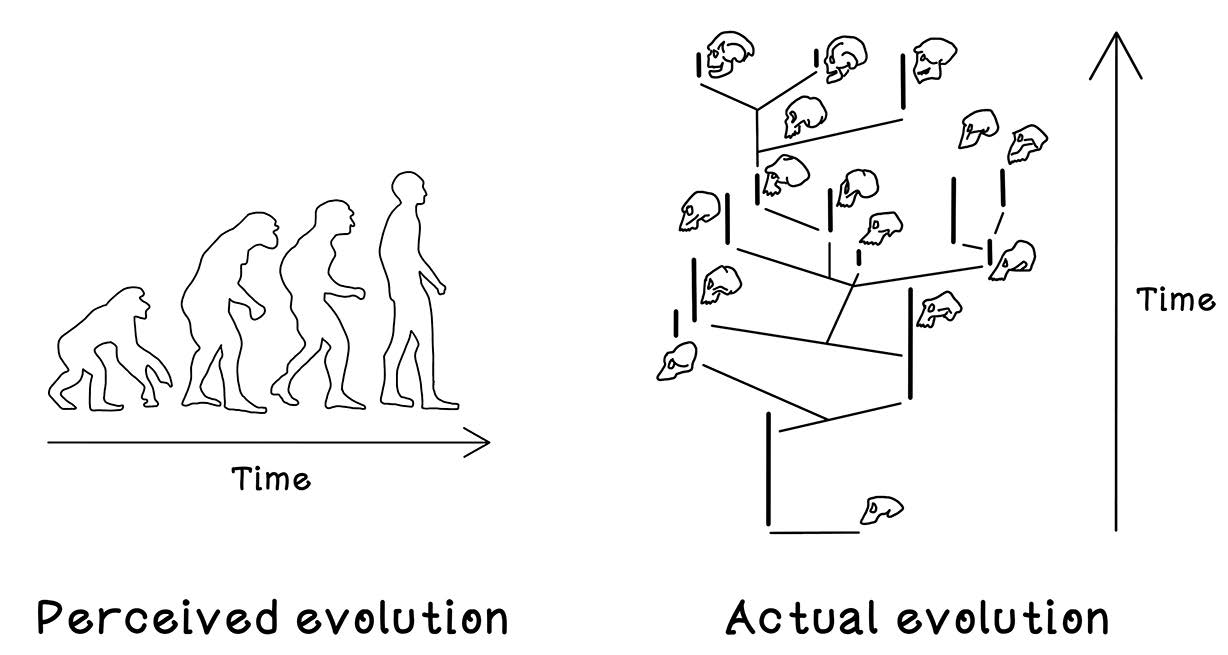
Evolution is not a straight ladder from primitive to modern forms. It branches into a changing cloud of variants: many disappear, while some thrive as environments favor their traits. section 4.1

Peppered moths

Light-colored moths were once common because they blended into light surfaces, while dark moths made up about 2% of the population. After the Industrial Revolution, dark moths reached about 95%, illustrating adaptation through differential survival. section 4.1

Figure 4.1 The idea of linear human evolution vs. actual human evolution
04_01

Compare the familiar linear picture of evolution with its branching reality. section 4.1

How Grokking AI Algorithms, Second Edition covers it

How deep it goes
Explains variation, mutation, branching populations, and selection through intuition and examples, stopping short of detailed biology.
Examples
Uses branching human evolution, peppered moth coloration, and reproduction with mutation to illustrate evolutionary change.
What you can do after
Evaluate/understand how populations change through inherited variation and environmental selection.
How it connects
Connects evolution with natural selection, mutation, adaptation, survival, reproduction, and evolutionary algorithms.

Also explained in

Compare how 3 books explain evolution →

Related concepts

This explainer was generated by Manning's knowledge graph from the text of Grokking AI Algorithms, Second Edition. The section links point to the parts of the book it draws on.

