liveBook · Manning

Archive search

As explained in Self-Improving Agents

An evolutionary search method that breeds candidate variants from an archive of previously found good variants.

When simpler searches cannot reach a needed improvement, evolutionary archive search breeds candidates from an archive of previously found good variants—not just the latest population. That deeper pool can reach further, but maintaining and evaluating it costs substantially more compute. section 1.4.2

Figure 1.11 The search family arranged by cost against improvement reach. Hill-climbing is the cheapest and most limited, pairwise and population methods cost more and reach further, reinforcement-learning searches fit policy-shaped artifacts, and evolutionary archive search is the most expensive and reaches the furthest. Meta-search sits apart, since it changes the search itself rather than spending more effort on the same curve.
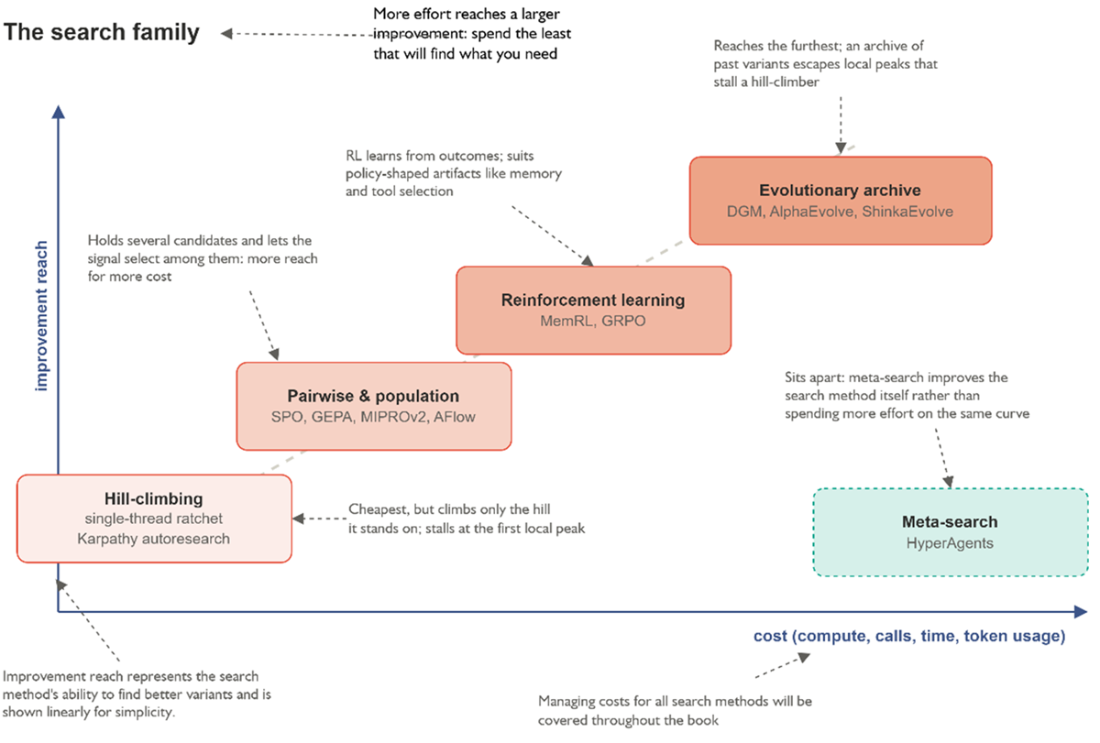
Compare search methods by cost and improvement reach: archive search reaches furthest at the highest cost, while meta-search changes the search itself. section 1.4.2
How Self-Improving Agents covers it

How deep it goes
Explains archive retention and cross-archive breeding, then compares its cost and improvement reach with other search families.
Examples
Names the Darwin Gödel Machine, AlphaEvolve, and ShinkaEvolve as examples of archive search.
What you can do after
Understand how archive search preserves good variants and trades greater improvement reach for greater compute cost.
How it connects
Connects archive search with population search, reinforcement-learning search, meta-search, and the Darwin Gödel Machine.

Related concepts

This explainer was generated by Manning's knowledge graph from the text of Self-Improving Agents. The section links point to the parts of the book it draws on.