An agent can produce a correct answer and still leave room for improvement. A signal can identify the gap, but a score alone cannot change the next answer. Search closes that gap by generating candidate versions of an artifact, measuring them with the signal, and selecting a better version. It is the propose-and-select step between measurement and applying a change in the act → signal → search → apply loop. section 1.2.1 section 2.3.1
Move the verdict to the front
A support agent answers a late-return question accurately but buries the yes-or-no verdict three sentences deep. An LLM-as-Judge flags that weakness against a directness rubric. Search proposes variants of the agent’s prompt and compares them with the original using the judge. The winning instruction tells the agent to begin with a direct yes or no, then explain. The model weights and task execution loop stay unchanged; the prompt is the artifact that improves. section 1.2.1 section 2.3.1
The reusable interface has two inputs: the current best artifact and a signal that can assess candidates. Propose makes variants; Measure scores or compares them; Select keeps a winner. Repeating those moves starts each round from the best candidate so far and ends when the allotted rounds run out. The output is a new artifact version with a link to its parent, allowing its lineage to be reconstructed before an apply step uses it. section 2.3.1 section 2.3.3
Figure 2.8 The search process. Search is the self-improvement loop run repeatedly: Propose generates a variant of the current best, Measure has the signal compare that variant against the current best, and Select applies the verdict, keeping the variant only when the signal preferred it. The signal does its work in Measure; Select is just the decision rule, with no second call to the signal. After the rounds run out, the best candidate becomes the new artifact.
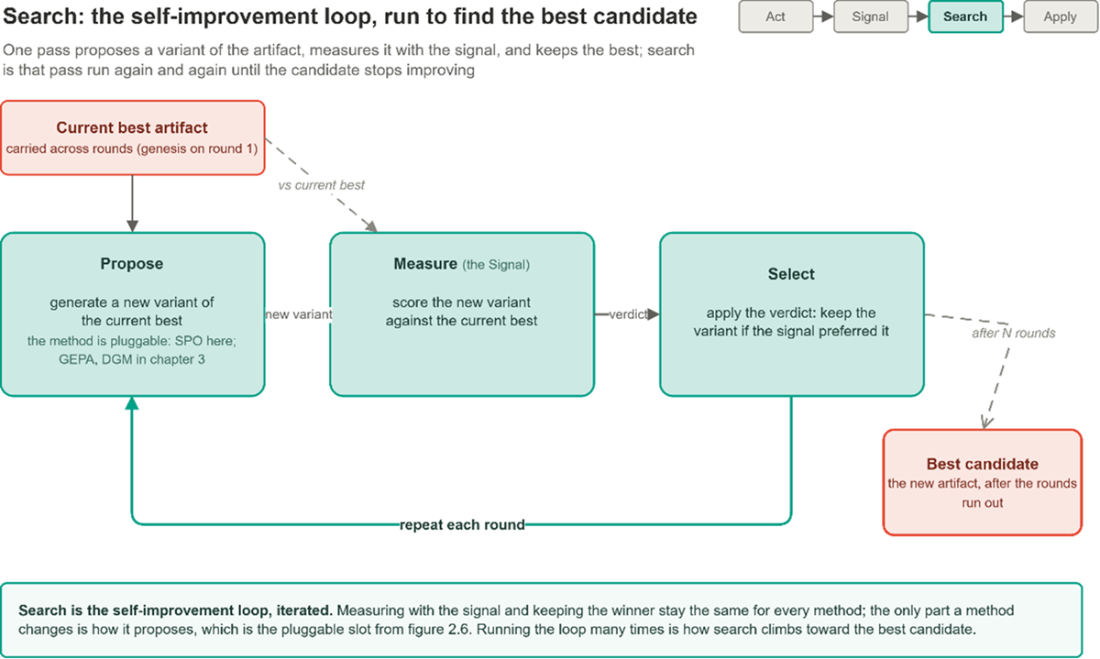
The diagram separates measurement from selection: Measure asks the signal to compare a proposed variant with the current best; Select applies that verdict without a second signal call. section 2.3.3
Choose a method to match the artifact and the effort available:
- Hill-climbing changes one candidate at a time and keeps an improvement. It is cheap, but can stall at a local peak. section 1.4.2
- Pairwise and population methods hold multiple candidates and explore more variants. SPO uses pairwise comparison; GEPA searches with a population. section 1.4.2
- Reinforcement-learning search fits policy-shaped artifacts such as episodic memory or tool selection better than prompts or code. section 1.4.2
- Evolutionary archive search spends more effort for greater improvement reach. Meta-search changes the search method itself rather than moving further along that cost curve. section 1.4.2
Start with the cheapest search that improves the measured result, and use a heavier method if it stalls. Signal, search method, and artifact are independent choices: the same loop can target a prompt, memory entry, planning routine, or code. Search cannot reliably improve what its signal cannot see. For offline changes, a selected winner still passes a deploy gate before reaching the running agent; scoring a run without searching and applying a change is self-evaluation, not self-improvement. section 1.2.2 section 1.5 section 2.3.1
