Pairwise and population search keeps multiple candidates in play: it generates variants and uses a signal to select among them, exploring more of the search space than a single-threaded hill-climber. section 1.4.2
Examples include:
- SPO compares candidates pairwise; GEPA breeds reflectively from a population using genetic-Pareto search. section 1.4.2
- MIPROv2 proposes instruction candidates using a Bayesian model of what tends to work; AFlow searches candidate workflows in a tree. section 1.4.2
Figure 1.11 The search family arranged by cost against improvement reach. Hill-climbing is the cheapest and most limited, pairwise and population methods cost more and reach further, reinforcement-learning searches fit policy-shaped artifacts, and evolutionary archive search is the most expensive and reaches the furthest. Meta-search sits apart, since it changes the search itself rather than spending more effort on the same curve.
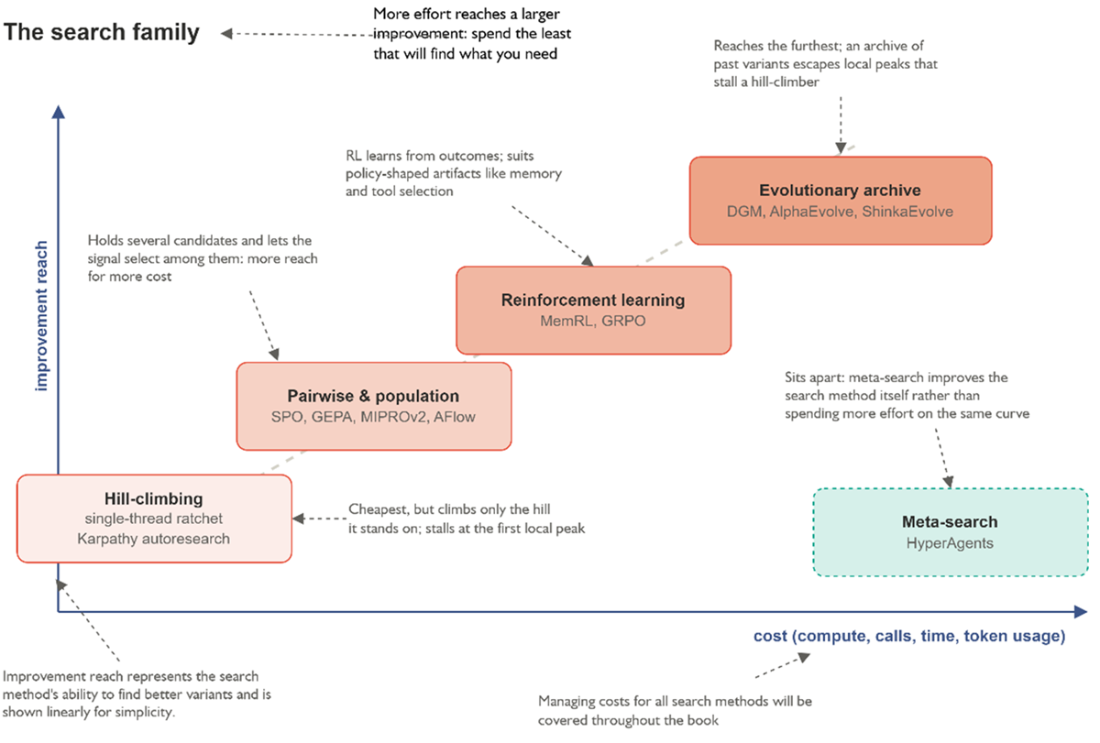
Compare this family’s cost and improvement reach with other search approaches. section 1.4.2