Reinforcement-learning search treats an artifact as a policy and improves it based on outcomes. It fits policy-shaped artifacts such as agent memory and tool selection; prompts and code are usually better suited to other search families. section 1.4.2
Two examples show how the method applies:
- MemRL learns values over episodic memory, favoring entries that have paid off on similar tasks. section 1.4.2
- GRPO learns which tools work best for task types by comparing groups of trajectories. section 1.4.2
Figure 1.11 The search family arranged by cost against improvement reach. Hill-climbing is the cheapest and most limited, pairwise and population methods cost more and reach further, reinforcement-learning searches fit policy-shaped artifacts, and evolutionary archive search is the most expensive and reaches the furthest. Meta-search sits apart, since it changes the search itself rather than spending more effort on the same curve.
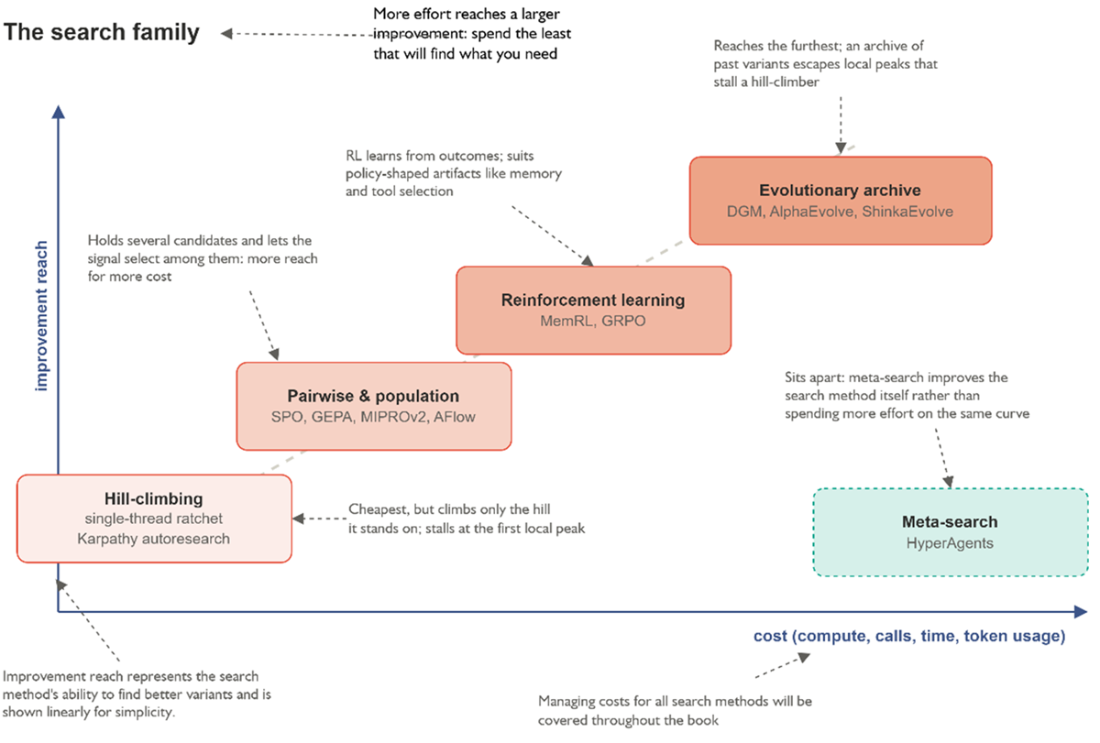
Shows where reinforcement-learning search fits among search families by cost, improvement reach, and artifact fit. section 1.4.2
