liveBook · Manning

Meta-search

As explained in Self-Improving Agents

Meta-search is a search method that searches for a better search procedure rather than directly searching for a better artifact.

Meta-search improves the search procedure rather than directly improving the artifact. An agent can keep an editable meta-procedure and rewrite how it searches; HyperAgents is a canonical example. section 1.4.2

Figure 1.11 The search family arranged by cost against improvement reach. Hill-climbing is the cheapest and most limited, pairwise and population methods cost more and reach further, reinforcement-learning searches fit policy-shaped artifacts, and evolutionary archive search is the most expensive and reaches the furthest. Meta-search sits apart, since it changes the search itself rather than spending more effort on the same curve.
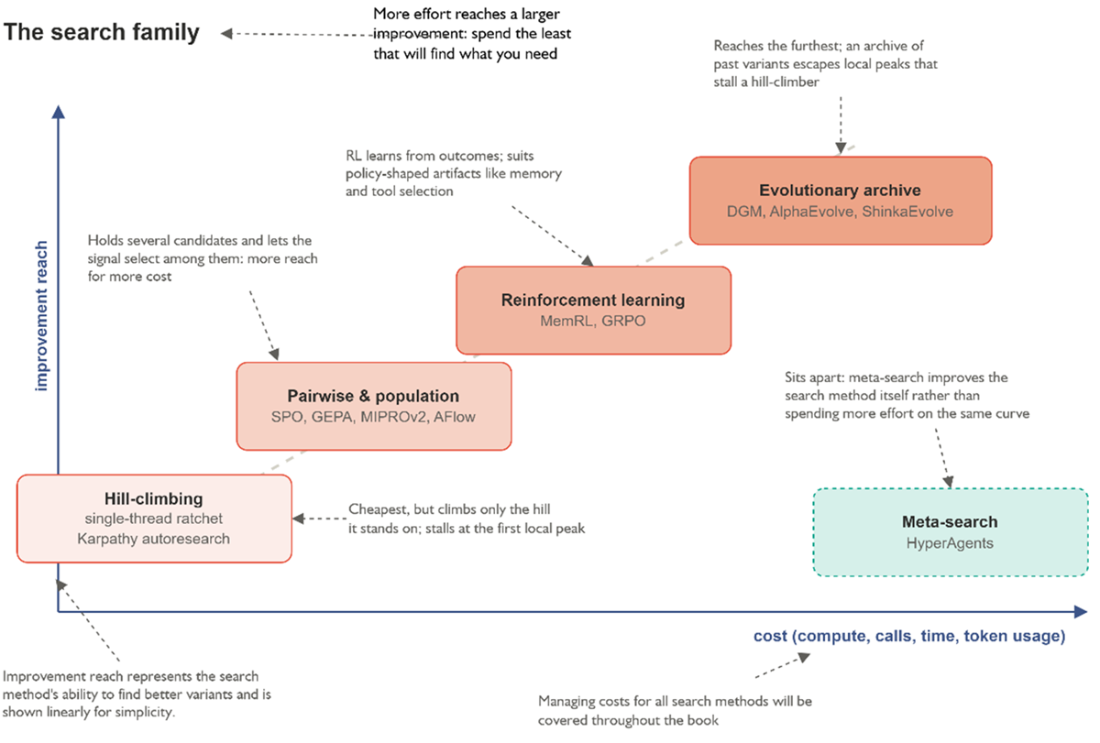
Shows meta-search apart from methods that spend more effort along the same cost-versus-improvement-reach curve. section 1.4.2
How Self-Improving Agents covers it

How deep it goes
Defines the distinction and names an editable meta-procedure, but gives no implementation steps.
Examples
Uses HyperAgents’ editable meta-procedure as the concrete example.
What you can do after
Evaluate whether an improvement changes an artifact or the procedure that searches for it.
How it connects
Relates meta-search to agent search methods and mutable, evaluable, versionable artifacts.

Related concepts

This explainer was generated by Manning's knowledge graph from the text of Self-Improving Agents. The section links point to the parts of the book it draws on.