A scenario called “Order Test” may exercise several behaviors without making clear which rule matters. An example map helps a team sort out that ambiguity before rewriting the scenario: it places concrete examples beside the rules they illustrate and keeps unanswered questions visible. section 2.5 section 7.3
In a workshop, four card colors give the conversation a simple structure:
- Yellow: the user story under discussion. Split or postpone parts that prove too large. section 2.5
- Blue: rules that group examples around a condition, often called acceptance criteria or business rules. section 2.5
- Green: concrete examples of how the system behaves under those rules. section 2.5
- Red: questions that block progress. Give each one an owner to resolve it before the next workshop. section 2.5
Finding the point of an old order scenario
A team revisits “Order Test” because its name reveals no particular rule. After mapping customer-collection behavior, they identify a more focused case: an unauthenticated customer chooses to pay on collection. The map helps them return to the scenario with a clearer intention rather than treating every step as equally important. section 7.3
Figure 7.1 Customer-collection example map
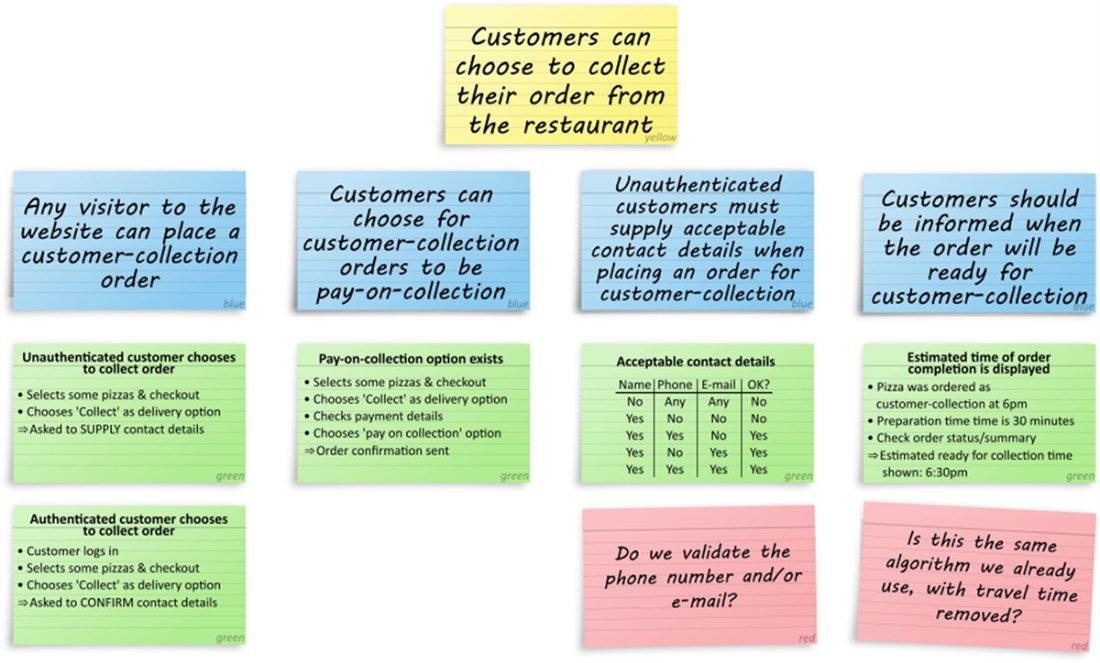
The customer-collection map provides a visual reference for the discussion that clarified the old scenario. section 7.3
A map is useful when existing behavior must be rediscovered, not just when planning something new. It records what the team has learned before they turn examples into readable scenarios and implement changes. The aim is a short, productive conversation with clear rules, examples, and next questions. section 2.5 section 11.2.1
