An exogenous variable represents variation determined outside the causal system being modeled. It collects unknown or unobserved factors that affect variables of interest and marks the model’s boundary with the rest of the world. section 7.1.3
In a causal model, Z, X, and Y are endogenous when their values depend on other modeled variables. The additional factors UZ, UX, and UY affecting them are represented as exogenous variables. section 7.1.3
The distinction supports modular causal reasoning:
- Represent each modeled variable with a function of its parents and its exogenous influences, such as X := fX(Z, UX). section 7.1.3
- Treat an unobserved factor as an exogenous component even when it is not stored because it is unavailable or judged unnecessary. section 7.1.3
- Use assumptions about exogenous terms when estimating effects; DML, for example, assumes E[U|D,C] = 0 and E[V|C] = 0. section 8.1.2
Price and sales
Suppose D is a product’s price and O is its sales. Unobserved influences on sales appear as U, while unobserved influences on price appear as V. The model separates these exogenous influences from the effect β of price on sales. section 8.1.2
Figure 7.7 Typical three-node DAG with confounding. Z is a confounder for X and Y.
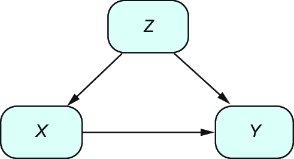
Use the three-node causal graph to inspect how modeled variables and external influences fit around a confounding structure involving Z, X, and Y. section 7.1.3

