liveBook · Manning

Expectation step

As explained in Data Without Labels

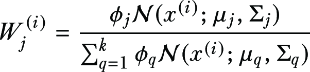
The expectation step of expectation-maximization estimates the probability that each observation belongs to each latent component using current model parameters.

The expectation step assigns each data point probabilistically to every Gaussian component in a Gaussian mixture model (GMM). It calculates the probability that each component generated the point, producing soft assignments rather than fixed cluster labels. section 5.6.1

Produces a probability matrix with:

(5.10)
figure

Inspect the probability formula underlying the normalized soft assignments. section 5.6.1

How Data Without Labels covers it

How deep it goes
Defines normalized probability calculations and their matrix output, then defers parameter updates to the maximization step.
Examples
Uses a dataset of n items and a data-point-by-Gaussian probability matrix.
What it assumes
Assumes Gaussian mixture components with means, covariances, and weights.
What you can do after
Evaluate how strongly each Gaussian component explains every observation.
How it connects
Connects GMM clustering with Gaussian distributions, soft assignments, and the maximization step.

Related concepts

This explainer was generated by Manning's knowledge graph from the text of Data Without Labels. The section links point to the parts of the book it draws on.