liveBook · Manning

Soft assignment

As explained in Data Without Labels

A soft assignment assigns an observation probabilistic degrees of membership across alternative clusters or model components.

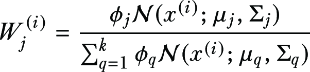
A soft assignment gives each data point a probability of belonging to every candidate cluster. In Gaussian mixture modeling, the expectation step calculates how likely the point is to have been generated by each of the k Gaussian distributions, producing a data-point-by-Gaussian matrix. section 5.6.1

The probabilities support the next EM update:

  • Normalize each Gaussian’s probability contribution for a data point. section 5.6.1
  • Weight covariance, mean, and distribution strength by the calculated probabilities. section 5.6.1
  • Repeat the expectation and maximization logic rather than assigning every point to only one cluster. section 5.6.1
(5.10)
figure

Use the probability formula to inspect how Gaussian likelihoods are normalized into soft assignments. section 5.6.1

How Data Without Labels covers it

How deep it goes
Defines probability calculation, matrix organization, and weighted parameter updates, while deferring mathematical proofs.
Examples
Illustrates data points, k Gaussian components, assignment matrices, and probability-weighted means and covariances.
What it assumes
Assumes Gaussian distribution parameters and contrasts probabilistic assignments with k-means averaging.
What you can do after
Evaluate cluster membership probabilities and understand how they weight Gaussian mixture parameter updates.
How it connects
Connects EM, Gaussian distributions, Gaussian mixture modeling, covariance, probability, and k-means clustering.

Related concepts

This explainer was generated by Manning's knowledge graph from the text of Data Without Labels. The section links point to the parts of the book it draws on.