Expected improvement (EI) is a Bayesian optimization acquisition function for expensive objectives. For each candidate, it scores the expected amount by which an evaluation could beat the incumbent—the best objective value observed so far. The next query is the candidate with the largest score. section 4.0 section 4.2
EI turns a simple optimization preference into a probabilistic decision: favor points that may improve on the current best result, but value a large possible gain more than a tiny one. Under a Gaussian-process belief about unseen objective values, this expected improvement can be computed in closed form. section 4.0 section 4.3
Figure 4.15 The difference between PoI (left) and EI (right). The former only cares whether we improve from the incumbent, while the latter considers how much improvement is made.
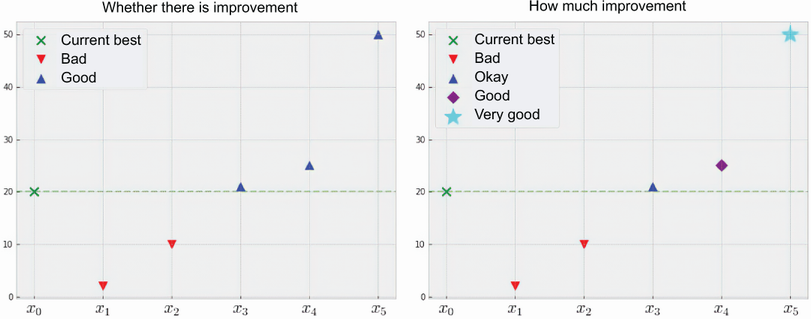
Compare EI with probability of improvement (PoI): PoI asks only whether a candidate can beat the incumbent, whereas EI also weights how far it could surpass it. Thus a candidate with a larger potential gain can outrank one with only a marginal improvement. section 4.3
This emphasis on magnitude helps EI avoid PoI’s tendency toward overly exploitative, risk-averse choices. EI naturally uses both predicted value and uncertainty: promising high-value regions support exploitation, while uncertain regions can remain attractive because they may yield a substantial improvement. section 1.2.2 section 4.5
Hyperparameter tuning
Suppose the best validation accuracy seen for a neural network is 90%. EI ranks candidate hyperparameter settings by their expected improvement over that benchmark, then evaluates the highest-ranked setting. In an exercise with a limited query budget, EI is compared with PoI by tracking when each first reaches at least 90% accuracy. section 4.0 section 4.4.2
EI belongs in an iterative loop: fit a GP to evaluated points, maximize the EI score, evaluate the objective at that recommendation, add the observation, and repeat. Early in a search, many uncertain locations can score well; after a region has been examined sufficiently, other regions may become more valuable. section 1.2.2 section 1.2.4
Sequential EI selects one next point. Simply taking several highest-scoring points for a parallel batch is wasteful because they can cluster near the same maximum. Batch EI instead evaluates improvement through the best outcome within a batch under a multivariate Gaussian belief. section 7.1.2 section 7.2.1
BoTorch setup
For a maximization problem, construct analytic EI with a fitted model and the current maximum observed target value as best_f; then optimize the acquisition score to choose the next evaluation. section 4.3 section 4.5

