Expedited Forwarding (EF) is a standardized DSCP marking for traffic sensitive to delay, jitter, and loss. It uses DSCP value 46, or binary 101110. section 10.3.3
DSCP occupies six bits in the IPv4 DiffServ byte and IPv6 Traffic Class field, providing 64 possible values. Unlike link-local PCP markings, DSCP can remain with a packet end to end unless another device changes it. section 10.3.3
Use EF as part of a standardized QoS marking scheme:
- Mark voice call traffic with EF, whose recommended DSCP value is 46. section 10.3.3
- Distinguish EF from Default Forwarding (DF), which represents best-effort traffic with DSCP value 0. section 10.3.3
- Apply QoS markings to address congestion-related delay, jitter, and packet loss; default forwarding otherwise uses one FIFO queue without prioritization. section 10.7
Voice traffic
A voice call can receive the EF marking: set the DSCP field to decimal 46, represented as 101110, so devices recognize its delay-, jitter-, and loss-sensitive treatment. section 10.3.3
Figure 10.12 The old and current definitions of the ToS/DiffServ byte. The old ToS byte defined the 3-bit IPP field for QoS marking. The current DiffServ byte defines the six-bit DSCP field for QoS marking.
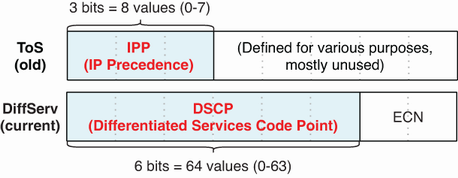
Compare the former three-bit IP Precedence layout with the current six-bit DSCP layout used for EF. section 10.3.3
