An explicit function gives one variable directly from others, providing a constructive recipe for generating points. In two dimensions, y = ax + b produces a line for chosen values of x. section 2.3.1
Use the representation with its geometric limits in mind:
- The formula y = ax + b describes nonvertical lines; a vertical line requires x = c instead. section 2.3.1
- An implicit equation can describe every line, but it does not construct points one at a time in the same direct way. section 2.3.1
- In three dimensions, producing z from x and y makes a plane, not a line. section 2.3.1
- A mathematical function assigns exactly one output to each input, distinguishing it from a general relation. section 2.4.1
Constructing a line
Choose a = 0.5 and b = 1. Evaluating y = 0.5x + 1 for successive x-values generates points on a straight line, as shown in the figure. section 2.3.1
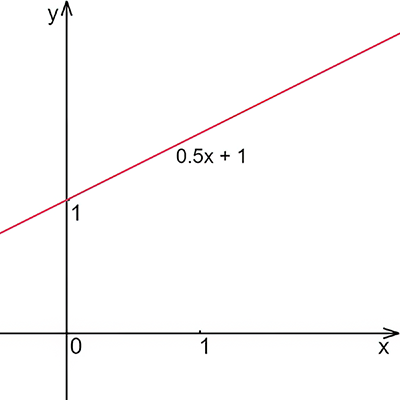
View the plotted example of an explicit line equation. section 2.3.1
