Explicit memory records moves visited during a search, giving tabu search a history that memoryless local search lacks. It helps prevent cycling and guides future choices. section 6.2.1
A simple tabu search uses two adaptive memory mechanisms:
- Recency-based or short-term memory tracks recently visited moves and prevents their immediate reuse. section 6.2.1
- Frequency-based or long-term memory counts how often moves occur and penalizes frequently used or less promising moves. section 6.2.1
Tabu structure for a four-city TSP
A tabu structure can record remaining tabu iterations for recently used moves alongside frequency counts for moves used throughout the search. section 6.2.1
Figure 6.5 Tabu structure for the 4-city TSP. The numbers in recency-based memory represent the number of iterations remaining for tabu-active moves; the numbers in long-term memory represent the frequency count of using the move.
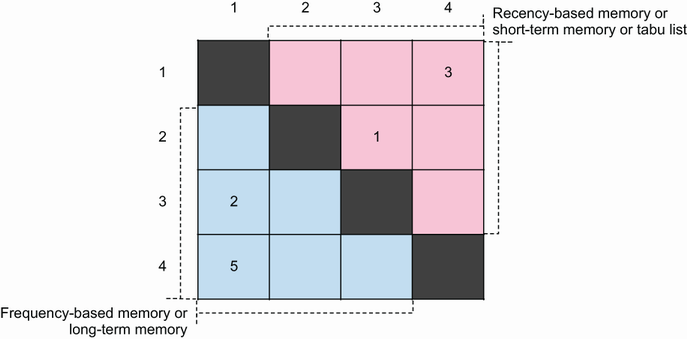
Visualizes recency-based tabu status and long-term frequency counts in a four-city traveling-salesperson search. section 6.2.1
