The exploration-exploitation trade-off is the choice between testing uncertain options and concentrating effort on options that already look good. Explore too much and evaluations may be spent on poor candidates; exploit too much and a better region may never be found. The balance matters whenever evaluations are limited and outcomes are uncertain. section 4.1.2 section 5.1.1
Figure 4.1 The exploration–exploitation tradeoff in BayesOpt. Each policy needs to decide whether to query regions with high uncertainty (exploration) or to query regions with a high predicted mean (exploitation).
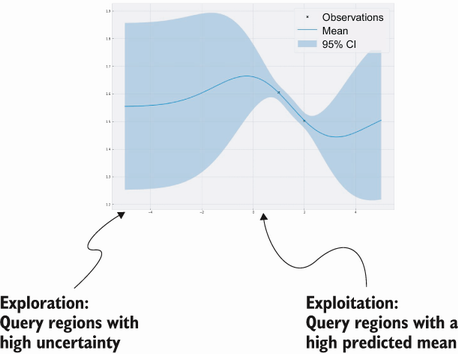
In Bayesian optimization, a policy can query uncertain extremes of the search space or the region with the highest predicted mean. The selected point expresses its exploration-exploitation balance. section 4.1
In a BayesOpt loop, a Gaussian process models observations, then an acquisition policy scores candidate points and chooses the next evaluation. Exploration favors regions with high predictive uncertainty, which may reveal an unknown high-performing area. Exploitation favors regions with high predicted objective values, making immediate optimization progress near a known good area. section 4.1.1 section 4.5
From familiar burgers to uncertain dishes
A restaurant choice makes the tension concrete: ordering a reliable burger exploits known quality, while trying an unfamiliar fish or steak explores a possibly better meal. Either extreme has a cost—an unsatisfying experiment or a missed favorite. section 4.1.2
BayesOpt policies balance the trade-off in different ways:
- Probability of Improvement (PoI) seeks a chance to beat the best observed value, but can be overly exploitative because even a tiny improvement is enough. Requiring an improvement of at least ε can encourage it to search elsewhere. section 4.4.1 section 4.5
- Expected Improvement (EI) scores the expected amount of improvement over the incumbent and generally balances exploration and exploitation better than unmodified PoI. section 4.0 section 4.5
- Upper Confidence Bound (UCB) uses μ + βσ as its acquisition score. A smaller β makes UCB more exploitative; a larger β places more weight on uncertainty and makes it more explorative. section 5.2.2
The balance need not remain fixed. As more observations tighten GP confidence intervals, UCB can drift toward exploitation because its upper bound approaches the predictive mean. Increasing β over iterations is a practical exploration schedule intended to counter that effect and reduce the risk of getting stuck near a local optimum. section 5.4.1
Unknown slot-machine rewards
With a limited number of pulls, a bandit policy must choose between a machine with a strong observed success rate and a less-tested machine with uncertain reward probability. Exploring can waste pulls, but always choosing the current leader can miss the truly best machine. section 5.1.1


