The exploration–exploitation trade-off balances learning which uncertain alternative performs best against using the alternative currently believed to deliver the highest return. section 8.2.6
Apply the trade-off when testing competing models or recommendations:
- Explore alternatives long enough to collect performance evidence, then stop investing in options that repeatedly underperform. section 8.2.6
- Measure outcomes explicitly, such as purchases, or implicitly through proxy signals such as browsing time; treat proxies cautiously because they can have competing interpretations. section 8.2.6
- Use the resulting feedback to evaluate models in production or controlled tests with real users. section 8.2.6
Three machines
Machine A pays frequently, machine B pays occasionally, and machine C never pays. After repeated failures, stop investing in B while continuing with A; the observed payout record supports the decision. section 8.2.6
Figure 8.2 Three one-arm bandits with pay-out records, where each block represents one pull. A light record indicates a zero reward, and a dark one indicates a positive reward. Machine A pays frequently, Machine B pays occasionally, and Machine C never pays.
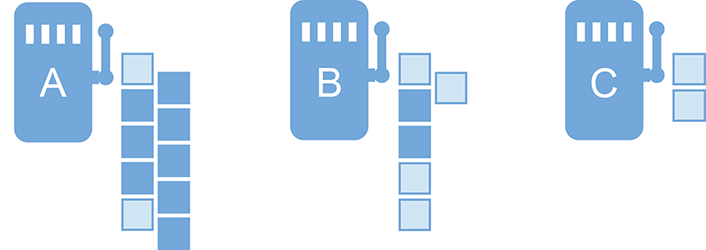
Compare payout records across three alternatives to see how exploration produces evidence for exploitation decisions. section 8.2.6


