Exponential growth accelerates dramatically as the input grows. Functions such as 2^n and 5^n + 2 may look manageable for small inputs, then skyrocket for larger ones. section 4.8
In algorithm analysis, exponential growth means:
- Small inputs are often manageable, but the required time or memory can become enormous quickly. section 4.9
- Values such as 2^n already become huge when n is greater than 30. section 4.16
- Exponential functions grow much faster than linear, linearithmic, or polynomial functions. section 4.8
Generating every subset
An algorithm that computes every subset of an array faces exponential growth. With 60 elements, the work could take centuries; with 100 elements, it reaches the order of magnitude of the age of the universe. This is why such algorithms are practical only for small arrays. section 4.9 section 4.16
Some of the growth rates you might encounter when studying algorithms. From left to right, the functions grow increasingly faster.
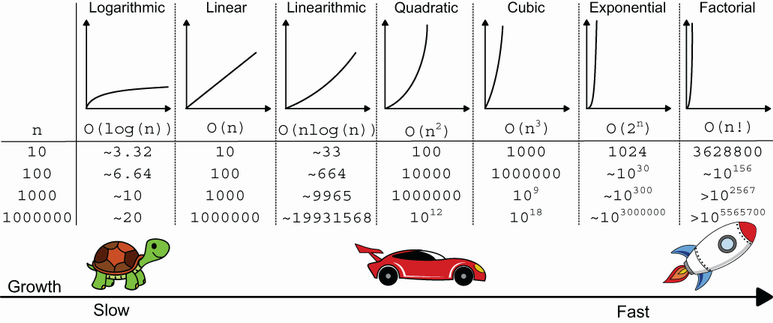
Use the growth-rate figure to compare exponential curves with slower classes and see how quickly their values separate. section 4.8
How long does it take to run an algorithm? That depends on the order of growth of its running time. All results are approximated.
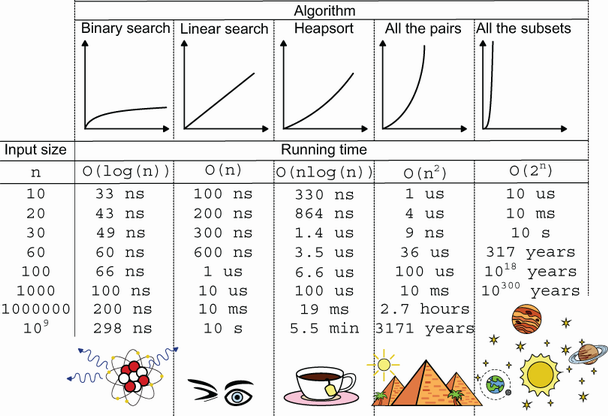
Use the running-time figure to connect exponential growth with practical execution times as input sizes increase. section 4.9
