liveBook · Manning

Exponential time complexity

As explained in Advanced Algorithms and Data Structures

An exponential-time algorithm has a running time that grows exponentially with the size of its input in the worst case.

Exponential time complexity describes running time that grows exponentially with input size. Exact solutions can become impractical quickly, even when each candidate is straightforward to check. section 17.2

Traveling-salesman planning

For delivery routing, an exact algorithm may examine possible city sequences. Ten cities already produce about 3.6 million sequences, 15 produce about 1.3 trillion, and 20 produce about 2.4 × 10^18. Even an exponential algorithm that improves asymptotically on factorial enumeration may handle only around 40 deliveries, or fewer in practice. section 17.2

Figure 17.8 An example map, mixing the DC Universe’s cities and other real ones, with some distances: because this is a complete graph with close to fifty edges, we are only showing a few numbers, almost only for the edges in the best tour (the thicker edges).
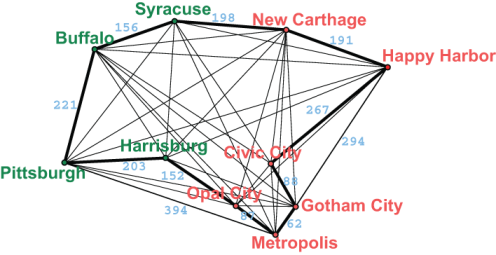
Use the route map to connect city count, candidate tours, and the practical limits of exact optimization. section 17.2


How Advanced Algorithms and Data Structures covers it

How deep it goes
Quantifies exponential growth against factorial enumeration but stops short of deriving a specific exponential algorithm.
Examples
Uses delivery routes with 10, 15, and 20 cities to show rapidly expanding candidate counts.
What you can do after
Evaluate when exact optimization becomes impractical and when planning or precomputation is necessary.
How it connects
Connects traveling-salesman problem with NP-completeness, NP-hardness, polynomial-time verification, and P versus NP.

Also explained in

Compare how 3 books explain exponential time complexity →

Related concepts

This explainer was generated by Manning's knowledge graph from the text of Advanced Algorithms and Data Structures. The section links point to the parts of the book it draws on.
