Extensibility is the ability to add capabilities or behaviors without changing a system’s core implementation. In cloud-native platforms, standardized APIs make new capabilities faster and cheaper to experiment with, integrate, and maintain. section 2.3.5 section 9.4
Kubernetes demonstrates extensibility by standardizing both distributed-service orchestration and the APIs surrounding that orchestration. The API boundary lets platform capabilities evolve without forcing every consumer to change its core application. section 2.3.5 section 9.4
Practical extensibility patterns include:
- Add functionality through sidecars that run beside an application container rather than modifying the application itself. section 2.3.5
- Use lifecycle pipelines for services and extensions to improve release quality and remove delivery bottlenecks. section 9.4
- Use adapter patterns and event-driven integrations to connect diverse systems while reducing integration complexity and coordination overhead. section 9.4
Refreshing secrets with a sidecar
A Kubernetes pod can run a sidecar that continuously loads updated secret values from a vault, allowing the application to receive current secrets without changing its application container. section 2.3.5
Figure 2.16 An example of a pod sidecar. This container runs a process alongside the application container to enhance functionality. In this example, a sidecar continuously loads a new secret value from a vault so that the application will always get the latest updates when secrets are requested.
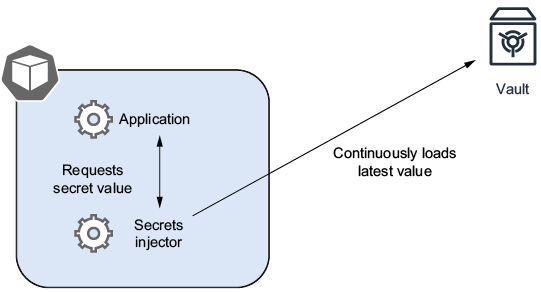
Inspect the sidecar arrangement to see how an adjacent container extends application functionality without modifying the application container. section 2.3.5






