An external domain-specific language defines domain artifacts outside application code, using separate text files and dedicated parsing and translation services. Engineers can describe hardware devices without coupling blueprints to the runtime’s hidden implementation protocols. section 3.3.1
Hardware blueprints
In a spaceship control system, engineers write external HDL files describing engines, fuel tanks, solar panels, and their sensors. The control software loads these declarations, translates them into HDL, and instantiates them in the runtime. A blueprint remains stateless, so multiple similar devices can be created from one description. section 3.3.1
The design separates domain descriptions from execution:
- External definitions live in separate files, potentially edited in a custom IDE. section 3.3.1
- Parsing and translation convert those definitions into the embedded HDL and its runtime. section 3.3.1
- Stateless declarations act as templates or blueprints rather than devices themselves. section 3.3.1
- The runtime can provide simplified representations for tests and hidden protocol-backed representations for production. section 3.3.1
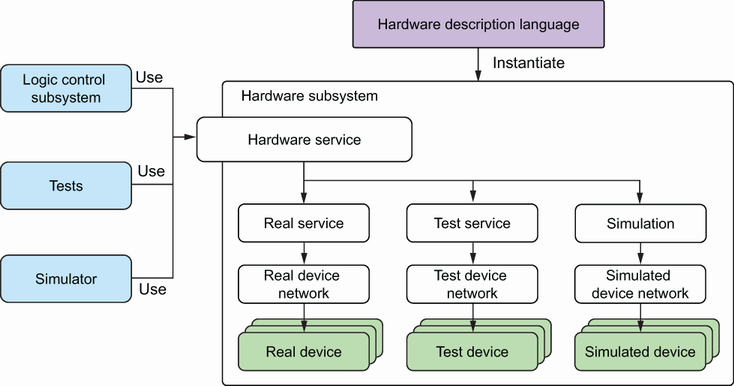
Use the hardware subsystem design to trace external descriptions through translation into runtime device representations. section 3.3.1
