The Façade pattern provides a unified, simplified interface to a complex subsystem of multiple interfaces. It makes code easier to use without modifying the subsystem classes. section 10.0 section 10.2
Apply the pattern by placing subsystem coordination behind a façade:
- Identify the repeated sequence of operations required by clients. section 10.2
- Create a façade class with a simpler operation that coordinates the subsystem classes. section 10.2.3
- Change clients so they depend on the façade instead of directly depending on every subsystem interface. section 10.2.3
- Keep subsystem details centralized, reducing duplication and limiting the impact of future subsystem changes. section 10.2.3
Fundraising façade
A college athletics department must solicit alumni, schedule booster-club meetings, and collect student fees. FundRaiser exposes do_fund_raising(), which performs those three calls. AthleticsDept and Administration each call only that façade operation, rather than constructing and coordinating Alumni, BoosterClubs, and Students themselves. section 10.2 section 10.2.3
Figure 10.7 The architecture modeled from the Façade Design Pattern hides the details of fundraising behind the façade class FundRaiser, which presents a higher-level interface that simplifies using the subsystem consisting of classes Alumni, BoosterClubs, and Students.
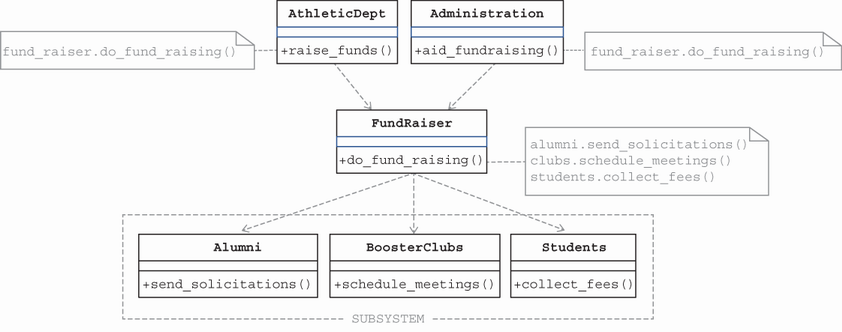
Use the architecture diagram to trace how FundRaiser hides Alumni, BoosterClubs, and Students from AthleticsDept and Administration. section 10.2.3


