An architectural subsystem is a part of a software system with a defined purpose and responsibilities. It might be a microservice, a module in a monolith, or another architectural unit. Its boundary matters more than its deployment form: when responsibilities align with a business subdomain and dependencies stay manageable, teams can change their parts of the system with fewer cross-team interruptions. section 12.0 section 12.3.1
A target architecture can align subsystems with subdomains, but legacy boundaries may not. Treat the boundary as a design hypothesis: examine how business scenarios cross it, then revise it when those scenarios expose awkward dependencies. Feedback from software design can also prompt changes to domain boundaries and team structure. section 12.0 section 12.2.3
When fewer boundaries work better
In an accounting-system redesign, a group initially drew four fine-grained boundaries. Testing them against real use cases led to two: fixed asset responsibilities, including sales, and computing tasks, including revaluation and depreciation. The larger, more cohesive subsystems reduced the complexity created by interactions between boundaries. Smaller was not automatically simpler. section 12.2.3
To review a proposed subsystem before committing to it:
- Test several real scenarios to see how subsystems communicate and where dependencies arise. section 12.2.3 section 12.3
- Consolidate what the scenarios reveal into one view of the subsystem; use a bounded context canvas to discuss its name, purpose, and strategic role. A precise name helps reveal misplaced responsibilities. section 12.3 section 12.3.1
- If the boundary remains uncertain, explore more detail through a code proof of concept or software design EventStorming. section 12.3
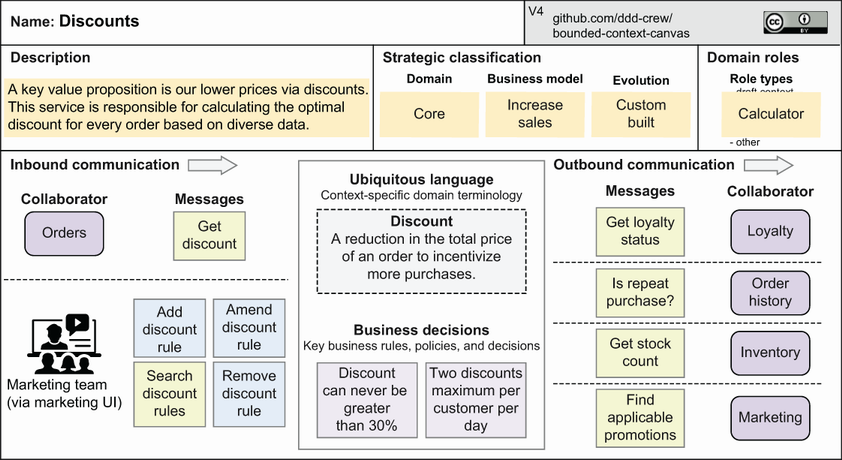
The bounded context canvas offers a shared visual check of an individual subsystem’s design, including whether its responsibilities fit its business purpose. section 12.3.1
Once a boundary is credible, decide how much of that subsystem to modernize. A complete rewrite is only one option; weigh its potential return against its cost and the delay it could introduce. Plan the move from current to target state rather than treating the target design as the finished work. section 12.4
