A factory encapsulates object creation so clients depend on a common interface instead of hardcoded concrete classes. A factory function receives a parameter, selects a subclass, and returns the resulting object at run time. section 7.4 section 7.6
A factory improves a design by:
- Hiding calls to new and construction details from client code. section 7.4
- Allowing one interface, such as Toy, to represent different concrete objects. section 7.4
- Moving creation responsibility into a related factory class or into subclasses through Factory Method. section 9.1.3
- Supporting extension with less coupling, fewer hardcoded behaviors, and stable client classes. section 9.1.3
Toys and athletic departments
ToyFactory::make(kind) returns a ToyCar, ModelAirplane, or TrainSet according to Kind. In the Factory Method design, AthleticsDept delegates create_sport() to VarsityDept and IntramuralDept, which create category-specific Sport objects while the shared reporting logic remains stable. section 7.4 section 9.1.3
Figure 9.2 This version of the application is modeled from the Factory Method Design Pattern. Superclass AthleticsDept delegates creating Sport objects to its subclasses. Subclasses VarsityDept and IntramuralDept are factory classes. Each implements the factory function create_sport(), which creates and returns an appropriate varsity or intramural Sport object. The grayed-out portions of the diagram have not changed logically from figure 9.1.
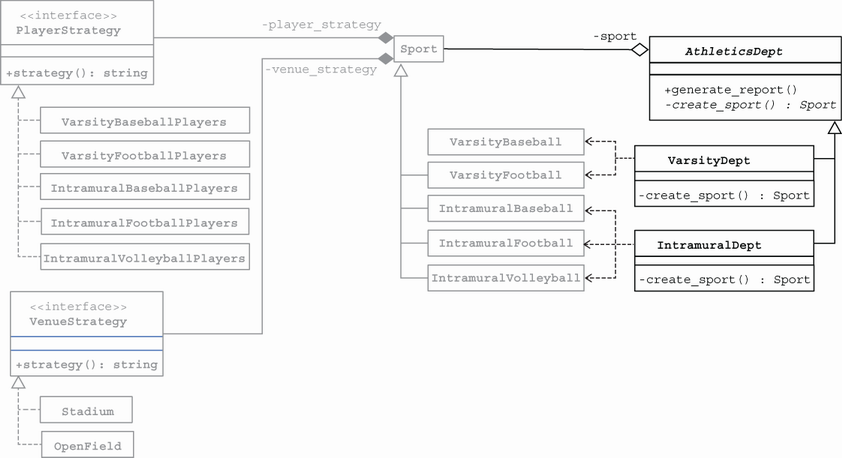
Shows subclasses acting as factory classes and delegating creation to category-specific implementations. section 9.1.3










