A fault-tolerant quantum computer suppresses hardware noise to arbitrarily low levels, enabling reliable execution of long quantum computations. section 1.3.2
It continuously runs quantum error correction as a protective layer around logical programs during hardware execution. Current systems instead rely mainly on error mitigation, which improves result accuracy without providing fault-tolerant operation. section 1.3.2
Reaching fault-tolerant operation requires:
- Reducing computational noise through continuous error correction. section 1.3.2
- Scaling the number of qubits significantly. section 1.3.2
- Demonstrating long computations with reliable results, rather than judging progress by raw qubit counts alone. section 1.3.2
Figure 1.2 The major milestones of quantum hardware development. The first two, showing the use of quantum mechanics to perform a computation and having a quantum computer solve an artificial problem that a classical computer cannot, have already been achieved. The next milestone, building a fault-tolerant quantum computer that can run long computations, is the current focus. The final goal is to build a quantum computer that can solve practical problems that a classical computer cannot.
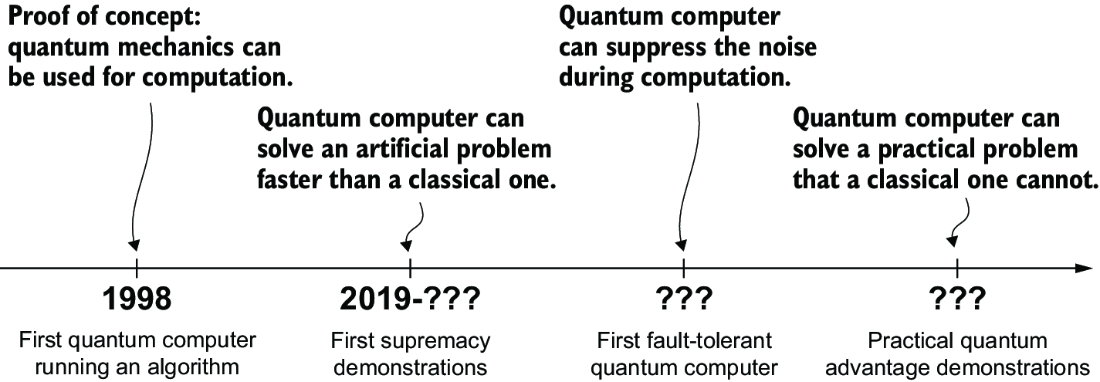
A milestone diagram places fault-tolerant quantum computing between early quantum demonstrations and the eventual goal of solving practically significant problems beyond classical reach. section 1.3.2
