Error correction enables reliable quantum computation from unreliable, noisy physical qubits. It protects a program’s logical qubits and logical gates by encoding them across multiple physical qubits, gates, and measurements. The result is not a noise-free computation, but error rates can be reduced to the level a computation requires. section 9.3 section 9.8
Fault-tolerant computers must run error correction continuously while executing a logical program. Current systems cannot yet do this at the scale needed for long computations; they instead use error mitigation to improve result accuracy on noisy devices. section 1.3.2
Error correction changes performance estimates because it adds substantial physical resources:
- A logical qubit is represented by multiple physical qubits. section 9.3
- A logical gate becomes a sequence of physical gates and measurements, often taking dozens or hundreds of operations. section 9.3
- Resource estimates must account for the error-correction code, logical connectivity, supported logical operations, gate and measurement times, and magic-state overhead. section 9.8
Short Grover search on noisy hardware
A Grover search over 16 or 32 values can succeed in most simulator runs, yet on current NISQ devices its outcomes may be distributed roughly evenly among all possible results. This illustrates why physical qubits cannot directly sustain even short noisy computations reliably. section 9.3
Figure 9.5 Physical qubits are noisy, they support a limited set of gates, and these gates are slow. We have to use error correction to enable reliable computation on noisy qubits. We also have to use a special process to implement arbitrary logical gates on logical qubits. These factors affect both the run time of algorithms on the quantum computers and the numbers of qubits required to run them.
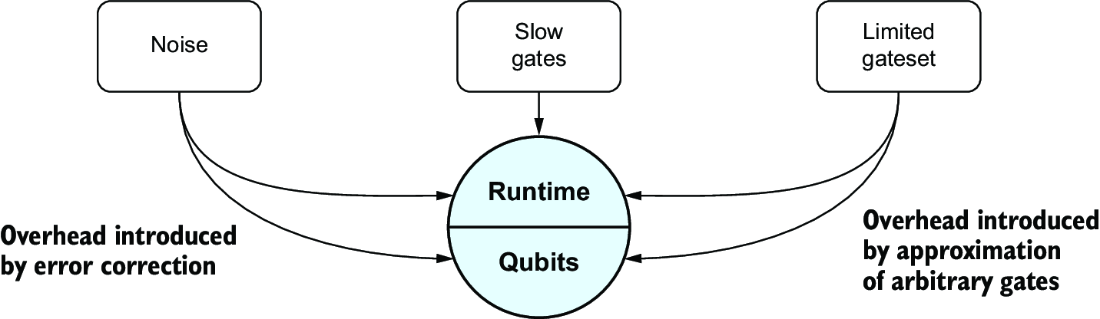
Compare the noisy physical layer with the error-corrected logical layer and see why both runtime and qubit requirements grow. section 9.3
