A feature, also called an attribute, is an input property used to predict an output. In phishing detection, sender ID, email-body length, and attachment count can become features; a model learns how they relate to a fraud or not-fraud label. Feature engineering is the manual extraction of such inputs from raw data. section 1.3
Features must fit the data and the detection approach. Classical models train on a tabular set of engineered columns, while deep learning can use raw email text directly instead of reducing it to a finite set of attributes. Audio detection likewise converts a detailed waveform into numerical audio features before model training. section 5.1 section 8.1.1
Figure 1.10 Demonstration of an email phishing fraud detection machine learning model. The feature engineering block extracts features/attributes from input data The ML model learns from labeled data (extracted features and corresponding fraud or not-fraud labels). The trained ML model is then used to predict whether a new email is fraudulent or not.
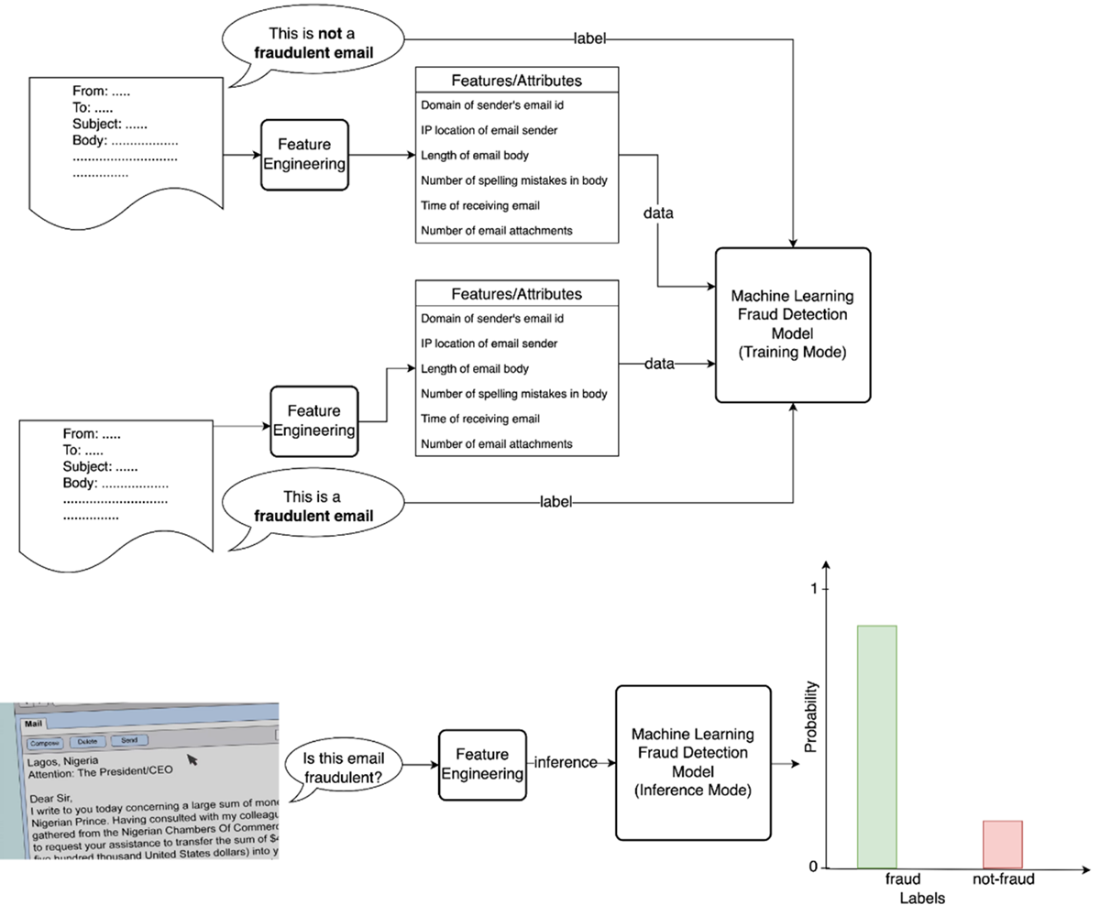
This pipeline shows feature engineering between raw email input and a labeled phishing classifier. section 1.3
A practical feature workflow is:
- Inspect numerical and categorical columns against the fraud label. Compare fraud and genuine distributions; recognize that identifier-like columns with many unique values may not suit categorical treatment. section 3.3.2
- Rank numerical features for their ability to separate fraud from genuine cases. An ANOVA F-test compares between-group variation with within-group variation, while availability at inference time and missing values also affect feature importance. section 2.1.2
- Examine promising values and turn simple patterns into rules. For example, test candidate thresholds for a numerical feature and measure each rule’s accuracy. section 2.2.2
- Create additional features from existing numerical and non-numerical data, then use a correlation matrix to check whether engineered features are directly correlated with existing ones. section 3.6
From webpage measurements to fraud rules
PctExtNullSelfRedirectHyperlinksRT has values −1, 0, and 1; a rule predicting fraud when its value is below 0 achieved 77.17% accuracy on the phishing dataset. NumDash needs a searched threshold because it spans many values: testing each observed value found 2 as the optimal threshold, though its rule reached 67.76% accuracy. Combining rules can change accuracy, so each combination needs evaluation rather than assumption. section 2.2.2
Figure 8.3 Conversion of an audio file into MFCCs. First, the audio file is read as a waveform. The waveform is then converted into the MFCC matrix.
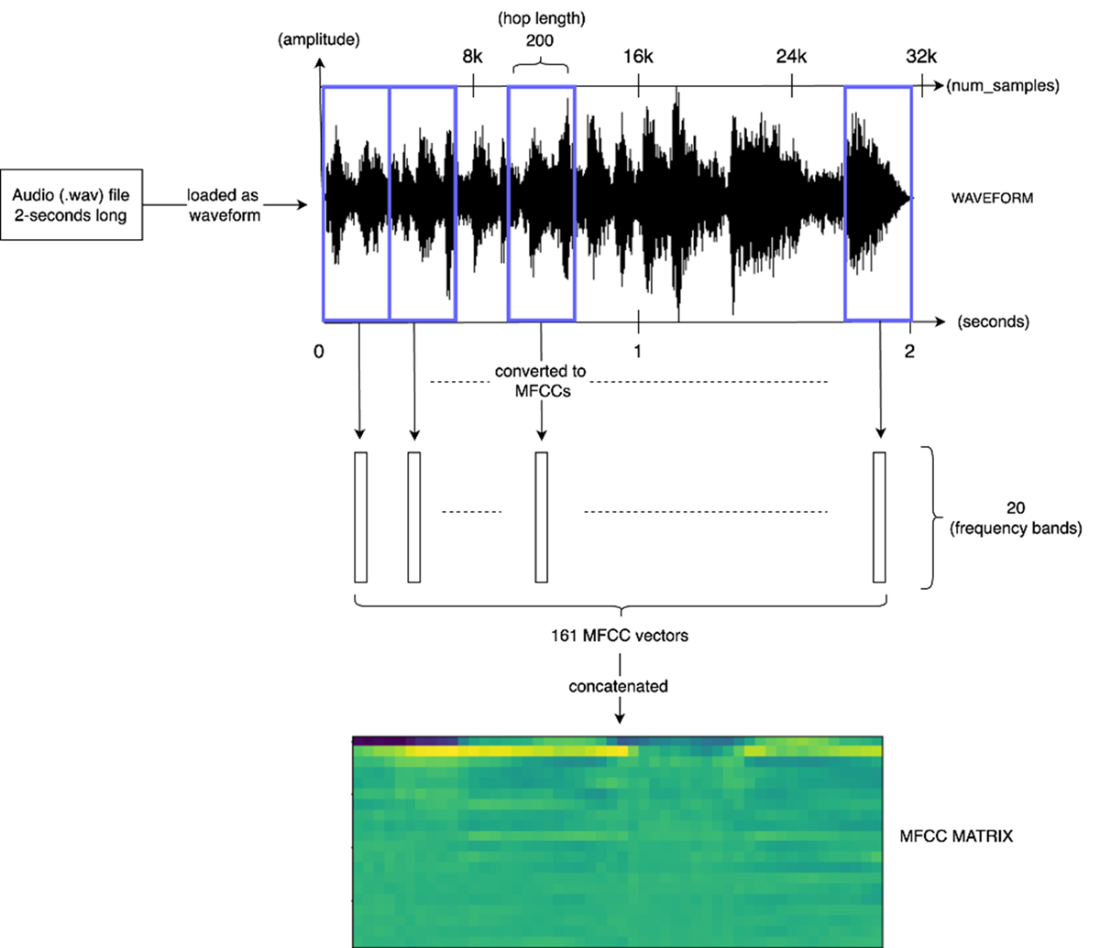
The diagram makes the transformation from raw voice file to MFCC feature matrix concrete. section 8.1.1
Feature choice is also an operational decision. Rules can be fast and interpretable, but manually examining attributes and maintaining many feature combinations does not scale well as fraud patterns grow more complex. Machine learning can learn feature combinations from data and improve with more training data, at the cost of less straightforward debugging and typically higher latency. section 3.1

















