Feature bagging detects anomalies in small feature subspaces instead of evaluating every feature together. Full-dimensional distances can hide points unusual in only a few dimensions, while different anomalies may require different subspaces. section 6.10
A FeatureBagging ensemble proceeds by:
- Selecting a random number of features for each base detector, up to a configured maximum. section 6.11
- Drawing a bootstrap sample of rows for that detector. section 6.11
- Running a detector on the resulting subspace, using LOF by default but permitting other base detectors. section 6.11
- Combining each row’s detector scores with either their maximum or their mean; the maximum usually preserves subspace-specific outlier strength better. section 6.11
The method is useful when an observation is ordinary across most dimensions but anomalous in a small combination of features. However, selecting too many features can revive the curse of dimensionality and make base detectors correlated. section 6.10 section 6.11
Figure 6.14 The left pane shows point A in a 2D dataspace. The point is unusual considering feature A but not if using Euclidean distances in the full 2D dataspace. Using additional features can be counterproductive. In the middle and right panes, we see another point, point B, which is an outlier in the C–D subspace but not in the E–F subspace. We need only features C and D to identify this outlier.
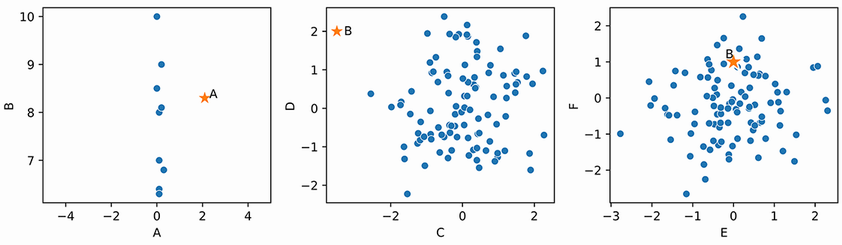
Compare how the same points appear in different feature subspaces, including cases where additional dimensions obscure an anomaly. section 6.10
