Dimension counts the independent coordinates needed to describe a point in a space. A vector with n elements represents a point in n-dimensional space; a two-element vector represents a point in a plane. section 2.1.1
Dimension connects mathematical representation with machine-learning geometry:
- In two dimensions, vector elements can serve as Cartesian x and y coordinates. section 2.1.1
- In higher dimensions, vectors represent points in high-dimensional spaces, while models can be viewed as geometric transformations between those spaces. section 2.1.1
- The same dimensional idea extends ellipse equations from two dimensions to n-dimensional hyperellipses. section 2.17
A two-dimensional hyperellipse
The equation 5x² + 6xy + 5y² = 20 describes a two-dimensional ellipse. Writing it with a matrix makes the construction extensible to multiple dimensions; diagonalizing that matrix and rotating the coordinate system aligns the coordinate axes with the ellipse’s axes. section 2.17.1
Figure 2.2 A vector describing the position of point P with respect to point O. The basic mental picture is an arrowed line. This agrees with the definition of a vector that you may have learned in high school: a vector has a magnitude (length of the arrowed line) and direction (indicated by the arrow). On a plane, this is equivalent to the ordered pair of numbers x, y, where the geometric interpretations of x and y are as shown in the figure. In this context, it is worthwhile to note that only the relative positions of the points O and P matter. If both the points are moved, keeping their relationship intact, the vector does not change.
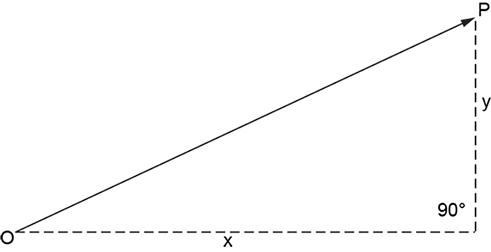
Use the geometric vector figure to connect coordinate counts with points, directions, and representations in a plane. section 2.1.1







