A feature extractor model transforms structured inputs into informative numerical features for a downstream model. In a neural-network–Gaussian-process combination, the neural network processes x before the GP mean function and kernel. This preserves the GP’s uncertainty-calibrated predictions while allowing flexible learned representations. section 13.3.1
Raw structured inputs, such as image pixels, may provide a poor basis for GP similarity calculations. Multiple nonlinear neural-network layers can instead learn continuous features whose geometry reflects the prediction task. Training learns both the representation and GP parameters by minimizing negative log likelihood with gradient descent. section 13.3.1 section 13.4
A practical feature-extractor model follows this flow:
- Pass each input through sequential linear and nonlinear layers. section 13.3.2
- Produce a low-dimensional representation; the demonstrated network maps 784 input values to two features. section 13.3.2
- Scale extracted values to a bounded range before applying the GP mean and covariance modules. section 13.3.2
- Optimize feature-extractor weights alongside GP and likelihood parameters. section 13.3.1
MNIST features
A four-layer PyTorch extractor maps flattened 28×28 MNIST images through widths 1000, 500, and 50 to two output features. After training with a GP, examples sharing a digit label cluster together and form a smooth label gradient. Such smooth representations are easier for the GP to learn than randomly swapped labels. section 13.3.2 section 13.3.2
Figure 13.10 Combining a neural network with a GP. The neural network processes the structured data input x first and then feeds the output to the mean function and the kernel of the GP.
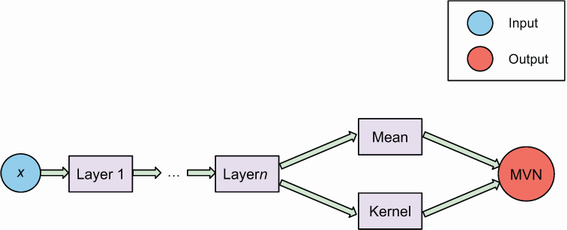
Trace the data path from structured input through the neural network into the GP mean and kernel. section 13.3.1
